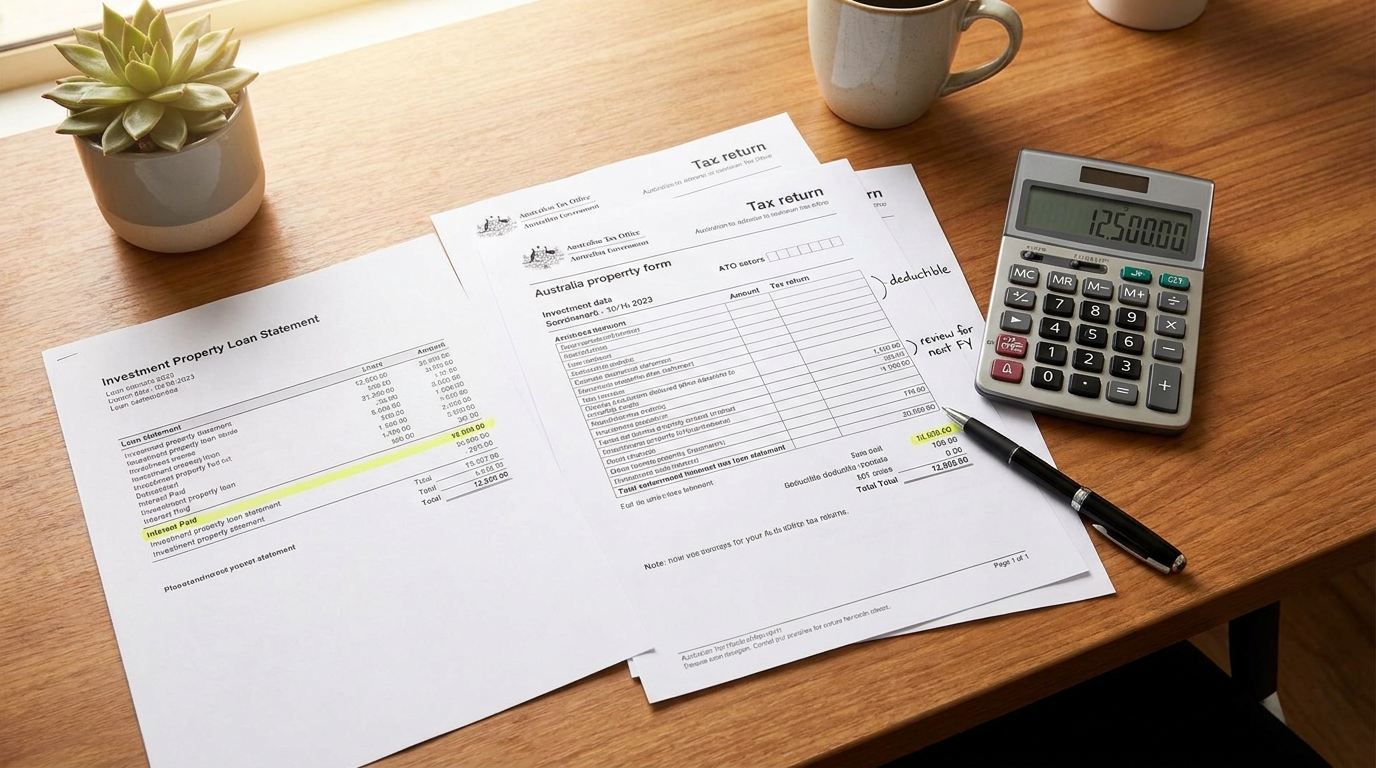
The short answer: In most cases, no. Australian investment property interest is tax-deductible while home loan interest isn't, so paying down investment debt quickly often costs more than keeping it, especially for investors on higher marginal tax rates. Prioritise non-deductible home loan debt first. Exceptions exist: approaching retirement, a portfolio under cash flow stress from rate rises, or genuine debt aversion, where paying off investment debt sooner can make sense despite the tax trade-off.
Should I pay off my investment property quickly in Australia? It's a question thousands of investors wrestle with, especially when interest rates climb and monthly repayments bite harder. The instinct to eliminate debt feels right, but in the Australian property investment landscape, paying off your investment property quickly can actually cost you more than keeping the loan. That's because investment property loan interest is tax-deductible, while your home loan interest isn't. The tax system rewards you for maintaining investment debt and penalises you for keeping personal debt. The debt repayment question sits within a broader investment strategy that balances tax efficiency, cash flow, and long-term wealth accumulation across your entire portfolio.
This article breaks down the financial mechanics, tax implications, and strategic considerations that determine whether accelerated repayment makes sense for your situation. You'll see worked examples comparing different approaches, understand how the Australian Tax Office treats investment debt versus home debt, and learn when paying off an investment property quickly might actually make sense despite the tax disadvantages. By the end, you'll have a clear framework for making this decision based on your income, tax bracket, risk tolerance, and wealth-building goals.
The Australian tax system creates a fundamental distinction between investment property loans and owner-occupied home loans. Understanding this difference is the foundation for answering whether you should pay off your investment property quickly in Australia.
When you borrow to purchase an income-producing asset, an investment property, the interest on that loan is tax-deductible. According to the Australian Taxation Office, you can claim the interest charged on money borrowed to buy a rental property as a deduction against your rental income. If your investment property generates $30,000 in annual rent and you pay $18,000 in loan interest, you only pay tax on the $12,000 difference (minus other deductible expenses like rates, insurance, and depreciation).
The effective cost of your investment loan is reduced by your marginal tax rate. An investor on a 37% tax bracket paying 6% interest on an investment loan has an after-tax interest cost of just 3.78%. That's because every dollar of interest paid reduces taxable income by a dollar, saving 37 cents in tax. Research from the Australian Bureau of Statistics shows that investment lending accounts for approximately 36% of all housing credit in Australia, with negative gearing remaining a cornerstone strategy for property investors.
Your primary residence loan receives no tax benefit. Every dollar of interest paid on your home loan comes from after-tax income with no deduction available. That same 6% interest rate costs you the full 6%, there's no tax offset. This creates a powerful incentive to prioritise paying down your home loan over your investment property loan when you have surplus cash.
Consider two loans of $500,000 each at 6% interest. Your home loan costs you $30,000 per year in interest with zero tax benefit. Your investment property loan costs $30,000 in interest but saves you $11,100 in tax (at 37% marginal rate), making the real cost $18,900. The home loan is costing you 58% more in real terms. This is why financial advisers consistently recommend maximising non-deductible debt repayment before touching deductible debt.
Beyond tax considerations, should I pay off my investment property quickly in Australia depends heavily on how that decision affects your cash flow, borrowing capacity, and ability to expand your portfolio.
Lenders assess your borrowing capacity based on your income minus all expenses and existing debt commitments. When you pay down your investment property loan, you reduce the monthly repayment obligation, which improves your serviceability for future borrowing. However, you also reduce your liquid cash reserves, which could have been used as deposits for additional investments. Investors holding Gold Coast properties in high-growth corridors may find that maintaining maximum deductible debt while the asset appreciates delivers better wealth outcomes than accelerated repayment.
Data from the Australian Prudential Regulation Authority indicates that lenders typically assess rental income at 80% of actual rent received when calculating serviceability, applying a buffer to account for vacancy and maintenance. If your investment property generates strong positive cash flow, paying it down faster removes a performing asset from your portfolio structure without necessarily improving your overall wealth position. The cash you direct toward extra repayments could instead fund deposits on additional properties that generate their own income streams.
Every dollar you put toward paying off your investment property quickly is a dollar not working elsewhere. If your investment loan sits at 6% interest (3.78% after tax at 37% bracket) and you can achieve 7-8% returns through shares, additional property, or even offset against your higher-cost home loan, you're moving capital from a higher-return use to a lower-return use.
Consider an investor with $50,000 in surplus cash. Option A: pay down the investment property loan, saving $3,000 per year in interest ($1,890 after tax). Option B: pay down the home loan, saving $3,000 per year in interest with no tax, a full $3,000 benefit. Option C: use it as a deposit on a second investment property generating positive cash flow and long-term capital growth. The mathematics consistently favour options B or C over option A for wealth accumulation.
Despite the tax and opportunity cost arguments against it, there are legitimate scenarios where you should pay off your investment property quickly in Australia. These situations typically involve risk management, life stage considerations, or specific financial goals that override pure wealth maximisation.
As you approach retirement, your income drops and your capacity to service debt diminishes. Carrying investment property debt into retirement means you need rental income to cover repayments, and if the property sits vacant or requires major repairs, you're drawing on super or savings to cover the shortfall. Paying off investment property before retirement eliminates this risk and converts the asset into a pure income stream.
Similarly, if you're highly applied across multiple properties and interest rate rises have pushed your portfolio into negative cash flow territory, reducing debt on your highest-interest or lowest-yield property can restore financial stability. According to the Reserve Bank of Australia, the cash rate increased from 0.10% in April 2022 to 4.35% by November 2023, adding hundreds of dollars per month to investor repayments. Some investors found themselves forced to sell or rapidly pay down debt to avoid financial stress.
Not every financial decision is purely mathematical. Some investors sleep better at night knowing they own their investment property outright, even if the spreadsheet says they'd be wealthier keeping the loan. If debt causes you genuine stress, affects your decision-making, or prevents you from taking other opportunities because you're psychologically constrained by the liability, paying it off may be the right choice for your circumstances.
The key is making this decision consciously, understanding the financial trade-off you're accepting. You're choosing peace of mind over tax efficiency and potential wealth accumulation, and that's a legitimate choice if it aligns with your values and life goals. Just don't confuse it with the financially optimal strategy. Understanding whether to pay off investment debt quickly requires first grasping the core property investment fundamentals that determine how Australian real estate builds wealth over time.
Rather than asking should I pay off my investment property quickly in Australia, sophisticated investors ask: how can I structure my debt to maximise tax efficiency while maintaining financial flexibility? The answer often involves debt recycling and offset account strategies.
An offset account is a transaction account linked to your loan where the balance offsets the loan principal for interest calculation purposes. If you have a $500,000 loan and $100,000 in your offset account, you only pay interest on $400,000, but you retain full access to that $100,000 for emergencies or opportunities.
The strategy: direct all surplus cash into an offset account linked to your non-deductible home loan, not your investment property loan. This reduces the interest you pay on non-deductible debt (where you get no tax benefit) while keeping your deductible investment property loan at its maximum balance (where the interest saves you tax). You achieve the interest savings of paying down debt without sacrificing tax deductions or liquidity. Research from Canstar shows offset accounts can save borrowers tens of thousands in interest over the life of a loan while maintaining complete access to funds.
Debt recycling is the strategy of progressively converting your non-deductible home loan into deductible investment debt. As you pay down your home loan or build equity, you redraw or refinance that equity to invest in income-producing assets, shares, managed funds, or additional property. The new loan is now deductible because it's funding an investment, while your home loan shrinks.
Over time, you shift your debt profile from expensive non-deductible debt to tax-effective deductible debt, while simultaneously building an investment portfolio. This is the opposite of paying off your investment property quickly, you're actually maintaining or increasing investment debt while eliminating home debt. It's a sophisticated strategy that requires careful structuring and professional advice, but it's how many wealthy Australians optimise their tax position while building portfolios. Some investors work with property investment specialists who model these structures across multi-property portfolios. For example, Somerstone Property Group provides portfolio modelling that maps debt recycling strategies across 10-year acquisition timelines, showing clients how each property and loan structure affects their overall tax and wealth position.
Ready to take the next step with Somerstone Property Group?
Our team is ready to help you achieve your goals. Book a discovery call.
Let's model three scenarios to see the financial impact of different approaches to the question: should I pay off my investment property quickly in Australia?
Investor profile: $120,000 annual income (37% tax bracket), $500,000 investment property loan at 6% interest, $30,000 annual rent, $50,000 in savings. Strategy: direct $50,000 toward investment property loan, then make extra repayments of $1,000/month.
Year 1 results: loan balance drops to $438,000 (after $50,000 lump sum plus $12,000 extra repayments). Interest paid: $27,420. Tax saved on interest: $10,145. Net interest cost: $17,275. The investor has reduced their loan but sacrificed $50,000 in liquid capital and reduced their annual tax deductions by approximately $1,800 (the interest on the $50,000 paid off). Over 10 years, this approach eliminates the loan but costs the investor the opportunity to deploy that capital elsewhere and reduces cumulative tax benefits by approximately $35,000.
Same investor, but with a $400,000 home loan at 6% interest alongside the investment property. Strategy: direct $50,000 toward home loan, then make extra repayments of $1,000/month to home loan. Investment property loan remains at $500,000. The same property selection criteria that identify high-performing assets also inform whether those assets warrant maximum leverage or accelerated debt reduction.
Year 1 results: home loan drops to $338,000. Interest saved on home loan: $3,720 (no tax benefit, so full $3,720 saving). Investment property interest remains $30,000, generating $11,100 in tax savings. Net position: $3,720 saved on non-deductible debt, $11,100 tax benefit retained on investment debt. Over 10 years, the home loan is eliminated in approximately 8 years, freeing up $2,400/month in cash flow. The investment property loan remains fully deductible, and the investor can then redirect the freed-up cash flow toward additional investments or paying down the investment loan if desired. This approach saves approximately $60,000 more in after-tax interest costs compared to Scenario 1.
Same investor. Strategy: place $50,000 in offset account linked to home loan, continue making minimum repayments on both loans, use improved serviceability to acquire second investment property with positive cash flow.
Year 1 results: home loan interest calculated on $350,000 instead of $400,000, saving $3,000 in interest. Investment property interest remains $30,000, generating $11,100 tax benefit. Second property acquired with $50,000 deposit (withdrawn from offset when needed), generating additional $8,000 annual cash flow and $6,000 in tax deductions. Over 10 years, this investor owns three properties instead of one, has built greatly more equity through capital growth across multiple assets, and maintains maximum tax efficiency. The offset account preserves liquidity for opportunities while delivering the interest savings of debt reduction.
The question should I pay off my investment property quickly in Australia cannot be answered with a universal yes or no. It depends entirely on your income, tax position, other debts, investment goals, risk tolerance, and life stage.
Start with your debt structure. Do you have a home loan with a higher interest rate than your investment loan? If yes, every dollar should go there first, you're saving more in non-deductible interest than you would on deductible interest. Next, assess your tax bracket. The higher your marginal rate, the more valuable your investment loan interest deduction becomes, and the less sense it makes to pay it off quickly. An investor on a 45% tax bracket has an after-tax loan cost of just 3.3% on a 6% loan, barely above inflation.
Consider your investment time horizon. If you're 35 and building a portfolio, maintaining maximum deductible debt and using equity to acquire additional properties will likely build more wealth than paying off property one. If you're 60 and planning to retire in five years, reducing debt to create stable retirement income makes more sense. Evaluate your risk tolerance honestly. Can you handle market volatility, interest rate rises, and temporary negative cash flow? If not, reducing debt provides stability even if it costs you some wealth accumulation.
These decisions involve complex interactions between tax law, lending policy, investment strategy, and personal circumstances. A qualified financial adviser or accountant can model your specific situation, showing you the projected outcomes of different strategies over 10, 20, or 30 years. They can structure debt recycling arrangements, optimise offset account usage, and ensure you're not inadvertently creating tax problems or limiting future opportunities. Some investors redirect capital from residential debt reduction toward commercial property acquisitions, where higher yields and longer lease terms can justify maintaining deductible debt across the portfolio.
The cost of professional advice, typically $2,000-$5,000 for full strategy work, is minor compared to the tens or hundreds of thousands of dollars at stake in these decisions. Don't rely on generic internet advice (including this article) to make a decision worth six figures. Use this information to understand the concepts and questions, then engage a professional to apply them to your specific circumstances.
Should I pay off my investment property quickly in Australia? For most investors in accumulation phase with a home loan and a marginal tax rate above 32.5%, the answer is no. The tax deductibility of investment loan interest, combined with the opportunity cost of capital and the benefits of maintaining borrowing capacity, means your wealth grows faster by keeping the investment loan and eliminating non-deductible debt first.
The exceptions are investors approaching retirement who need to reduce risk, those with no home loan or other non-deductible debt to prioritise, or individuals for whom debt creates genuine psychological stress that outweighs financial optimisation. For everyone else, the smarter strategy is debt recycling, offset account optimisation, and portfolio expansion, not rushing to pay off the one loan that actually delivers tax benefits. The Australian tax system rewards strategic debt management. Use it to your advantage.
High interest rates increase the dollar cost of your loan but don't change the tax deductibility. Your after-tax interest cost on an investment loan remains greatly lower than on a home loan. Focus on paying down non-deductible debt first, regardless of rate environment.
You lose the interest deduction permanently. Once the loan is paid off, you cannot re-borrow against that property and claim the interest as deductible unless the new loan funds another income-producing investment. The tax benefit is gone.
Technically yes, but it's financially backwards. Offset accounts reduce the interest you pay, which reduces your tax deduction. You're better off using offset accounts against your non-deductible home loan where you get the interest saving without losing any tax benefit.
Rarely during accumulation phase. It can make sense approaching retirement when income drops and risk tolerance decreases, or if you have no other non-deductible debt and want to free up cash flow for additional investments. Otherwise, maintaining deductible debt builds more wealth.
Maximise your deductible investment debt and minimise non-deductible personal debt. Use offset accounts against your home loan, keep investment loans at their full balance, and consider debt recycling to progressively convert home debt into investment debt. Seek professional advice for your specific situation.
Book a strategic portfolio review to model how different debt structures affect your long-term wealth position across multiple properties.
