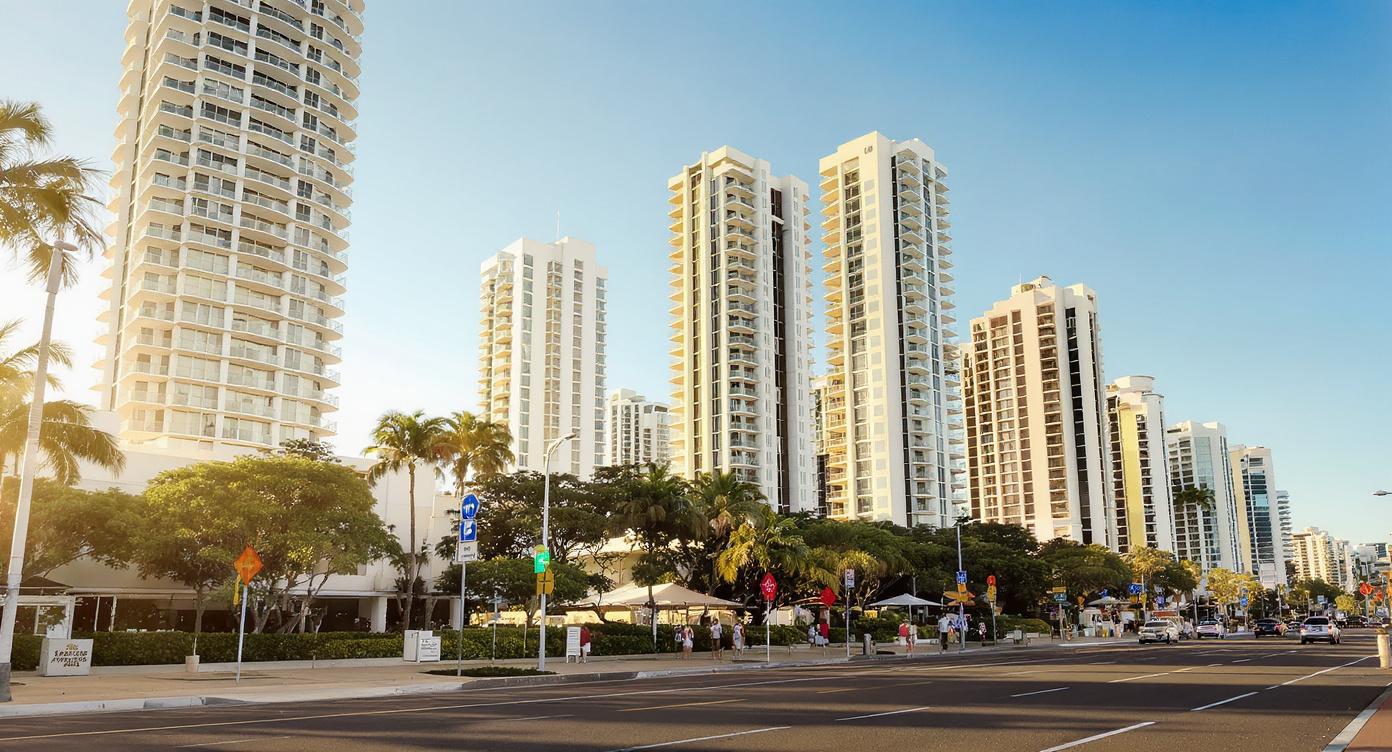
The short answer: Buying an investment property on the Gold Coast in 2026 means matching suburb and property type to strategy, not just buying near the beach. Median house prices sit at $1.17 million, up 127.7% over a decade. Standard houses and units yield 3.8-5.5% gross, often requiring negative gearing, while dual-key or triple-key setups can reach 6-7% gross yield. Southport suits cashflow; Burleigh Heads suits capital growth.
Investment property Gold Coast Australia opportunities have fundamentally shifted in the past 24 months. What worked in 2020, buying anything near the beach and riding the wave, no longer applies. The Gold Coast property market has matured. Median house prices now sit at $1.17 million, up 127.7% over the past decade according to CoreLogic data. That growth has been spectacular, but it's also changed the investment equation. You can't just buy and hope anymore. If you're weighing whether to buy an investment property on the Gold Coast while renting closer to work in Sydney or Melbourne, a rentvesting calculator helps you model the cashflow and wealth outcomes of that split strategy over 10-20 years.
The real question for investors in 2026 isn't whether the Gold Coast is a good market, it's where specifically, what property type, and what strategy aligns with your borrowing capacity and cashflow requirements. This article breaks down the current investment property Gold Coast Australia landscape using actual market data, suburb-level analysis, and strategic frameworks that account for yield, growth, and risk. You'll see where the numbers work, where they don't, and how to structure an acquisition that performs from day one rather than draining your serviceability for years.
The Gold Coast has evolved from a tourism-dependent economy into a diversified city with genuine population and employment growth. Net interstate migration into the Gold Coast reached record levels post-pandemic and has sustained through 2025-26, with professionals relocating from Sydney and Melbourne for lifestyle and cost-of-living reasons. According to ABS regional population data, the Gold Coast added approximately 15,000-18,000 new residents annually between 2021 and 2025, that's sustained demand that underpins rental markets.
Population growth alone doesn't guarantee investment returns, but when combined with infrastructure spending, it creates genuine underlying demand. The Gold Coast has seen major government and private sector investment over the past five years: Stage 3 of the light rail extending to Burleigh Heads (completed 2023), the $670 million Gold Coast University Hospital expansion, and the ongoing development of the Gold Coast Health and Knowledge Precinct. These aren't speculative announcements, they're operating infrastructure that attracts employment and supports population retention.
Employment diversity has improved substantially. While tourism and hospitality remain important sectors, health care, education, construction, and professional services now account for a growing share of the workforce. Data from the Queensland Government Statistician's Office shows healthcare and social assistance employment on the Gold Coast grew 18% between 2020 and 2025. That diversification reduces the risk of economic shocks that single-industry towns face.
When evaluating investment property Gold Coast Australia opportunities, this macro context matters because it determines whether rental demand is structural or cyclical. A location with growing population, diversifying employment, and active infrastructure investment has fundamentally different risk characteristics than a location relying solely on tourism or mining.
Rental yields on the Gold Coast vary dramatically by suburb and property type. According to SQM Research, gross rental yields for Gold Coast houses averaged 3.8-4.2% in early 2026, while units delivered 4.5-5.5%. Those are respectable yields compared to Sydney (2.8-3.5%) and Melbourne (3.2-4.0%), but they're not automatically positive cashflow once you account for mortgage repayments, body corporate fees, council rates, and property management.
A $700,000 unit in Southport generating $650 per week ($33,800 annually) delivers a 4.8% gross yield. After a 10% property management fee, $3,500 in body corporate levies, $2,800 in council rates, and $1,200 in insurance, net rental income is approximately $24,000. With an 80% LVR loan ($560,000) at 6.5% interest-only, annual interest is $36,400. That's a $12,400 annual shortfall before accounting for depreciation deductions, classic negative gearing territory.
This is why property type and structure matter enormously. Standard units and houses on the Gold Coast often require negative gearing. Dual-key and triple-key configurations that generate multiple rental streams from a single property title can push yields to 6-7% gross, fundamentally changing the cashflow mathematics. When assessing investment property Gold Coast Australia options, the yield profile determines whether you're building a self-sustaining portfolio or one that drains your borrowing capacity with every acquisition.
Not all Gold Coast suburbs deliver the same investment outcomes. Median prices, rental yields, vacancy rates, and tenant demographics vary substantially across the region. The key is matching suburb characteristics to your investment strategy, growth-focused, yield-focused, or balanced.
Southport consistently delivers some of the Gold Coast's highest rental yields, particularly for units. Median unit prices sit around $550,000-$650,000 (CoreLogic, 2026), with weekly rents of $600-$700 for two-bedroom apartments. That translates to gross yields of 5.0-5.8%. Southport benefits from proximity to the hospital precinct, Griffith University, and the light rail, which supports consistent rental demand from healthcare workers, students, and young professionals. The Gold Coast's 127.7% growth over the past decade sits well above the national average return on property investment across Australian capital cities, but understanding how that compares to long-term data helps set realistic expectations for the next cycle.
Labrador and Biggera Waters offer similar yield profiles with slightly lower median prices. Units in these suburbs often trade in the $450,000-$550,000 range, with rents of $550-$650 per week. The tenant base skews toward essential workers, retirees, and families seeking affordable waterfront proximity. Vacancy rates in these suburbs have remained below 2% through most of 2025-26 according to SQM Research, indicating tight supply and strong rental demand.
Robina presents a different yield opportunity, larger townhouses and dual-occupancy properties that appeal to families. Median townhouse prices are $650,000-$750,000, with weekly rents of $700-$850. The Robina Town Centre, multiple schools, and established residential character support long-term tenant retention. For investors seeking investment property Gold Coast Australia opportunities that combine yield with tenant stability, Robina's family-oriented rental market reduces turnover costs and vacancy risk.
Burleigh Heads and Palm Beach have delivered the strongest capital growth on the Gold Coast over the past five years, with median house prices increasing 80-90% between 2020 and 2025. Burleigh median house prices now exceed $1.8 million, with units around $900,000-$1.1 million. These are premium markets with lifestyle appeal, limited new supply due to geographic constraints, and strong owner-occupier demand.
The trade-off is rental yield. Gross yields in Burleigh typically sit at 3.0-3.5% for houses and 3.8-4.5% for units, well below the Gold Coast average. These are not cashflow properties. They're capital growth plays suited to investors with high incomes who can absorb negative gearing and who are prioritising long-term wealth accumulation over immediate income.
Mermaid Beach and Miami occupy a middle ground, strong growth over the past five years (60-70% for houses) with slightly better yields than Burleigh (4.0-4.5% for units). These beachside suburbs benefit from proximity to Burleigh's lifestyle amenities without the same price premium. For investors seeking investment property Gold Coast Australia options that balance growth and yield, these suburbs offer a compromise, though neither metric will be best-in-class.
Property type determines your investment outcomes more than almost any other factor. The same suburb can deliver radically different yields, cashflow, and growth depending on whether you buy a house, a unit, or a dual-key configuration.
Units dominate the Gold Coast investment property landscape for good reason: lower entry prices, higher rental yields, and proximity to employment and transport nodes. A $600,000 two-bedroom unit in Southport or Labrador generating $32,000 in annual rent delivers a 5.3% gross yield, substantially better than a $1.2 million house in the same suburb generating $50,000 (4.2% yield).
The risks are equally clear. Body corporate fees on Gold Coast units range from $3,000-$8,000+ annually depending on building age, facilities, and sinking fund requirements. Older high-rise buildings with pools, gyms, and lifts can have body corporate fees exceeding $10,000 per year, which destroys cashflow. Oversupply is another concern, Southport and Surfers Paradise have seen large apartment construction over the past decade, and some buildings have high vacancy or struggle with capital growth due to market saturation.
When evaluating units as investment property Gold Coast Australia options, the building quality, body corporate financials, and local vacancy rates matter as much as the purchase price. A cheap unit with high levies and poor management is a wealth destroyer, not a wealth builder. Research from the Owners Corporation Network shows well-managed buildings with adequate sinking funds appreciate 15-20% more over 10 years than poorly managed equivalents.
Dual-key properties, two self-contained dwellings under a single title, fundamentally change the investment equation on the Gold Coast. A $650,000 dual-key property in Coomera or Pimpama generating $750 per week ($39,000 annually) from two tenancies delivers a 6.0% gross yield. That's 40-50% higher than a standard house at the same price point, and the dual-income structure provides vacancy risk mitigation, if one tenant leaves, the other continues paying rent.
The Gold Coast's northern growth corridor (Coomera, Pimpama, Ormeau) has seen meaningful dual-key and granny-flat development over the past five years, driven by investor demand for high-yield, positive-cashflow properties. These suburbs benefit from affordability (median house prices $650,000-$800,000), proximity to the M1 motorway for Brisbane commuters, and large land parcels that support dual-occupancy configurations. Deciding whether the Gold Coast represents the best property investment for your portfolio requires comparing its yield, growth, and risk profile against other Australian markets with similar infrastructure and migration patterns.
One approach to investment property Gold Coast Australia that prioritises cashflow over location prestige is the dual-key strategy in growth corridor suburbs. Somerstone Property Group structures portfolios around these multi-income properties, sourcing dual-key and triple-key configurations across Queensland that generate up to 6-7% gross yields and positive cashflow from settlement. The trade-off is typically lower short-term capital growth than beachside suburbs, but the superior cashflow preserves borrowing capacity for subsequent acquisitions, enabling faster portfolio expansion.
Triple-key properties (three dwellings under one title) are rarer on the Gold Coast due to council zoning restrictions, but where available they push gross yields toward 7%+ and create exceptionally strong cashflow positions. For investors with major equity who want to accelerate portfolio income without multiplying transaction costs, triple-key strategies represent one of the highest-yielding residential structures in the Australian market.
Borrowing capacity is the limiting factor for most property investors, and the Gold Coast market's price appreciation has made serviceability more challenging than five years ago. Understanding what lenders assess and how to structure your application determines whether you can acquire one property or build a portfolio.
Lenders assess borrowing capacity by calculating your net income (salary, rental income, other sources) minus all committed expenses (existing mortgages, credit card limits, personal loans, living expenses) and then stress-testing at an interest rate 2.5-3% above the actual loan rate. For a $700,000 investment property loan at 6.5%, the bank assesses serviceability at 9.0-9.5% to ensure you can still afford repayments if rates rise.
According to the Australian Prudential Regulation Authority (APRA), lenders must use a minimum serviceability buffer of 3% above the loan rate as of July 2026. This buffer has reduced borrowing capacity across the market by approximately 20-25% compared to pre-2021 settings. For investors, this means a household income of $150,000 that could previously support $900,000 in total lending might now only support $700,000-$750,000.
Loan-to-value ratio (LVR) limits for investment property Gold Coast Australia purchases are typically 80-90%, depending on the lender and the borrower's financial profile. First-time investors with strong income and minimal debt can sometimes access 90% LVR with lenders mortgage insurance (LMI), while portfolio investors with multiple properties often face 80% LVR caps. LMI on a $700,000 property at 90% LVR ($630,000 loan) costs approximately $18,000-$22,000, a meaningful upfront cost that should be factored into acquisition budgets.
Lenders typically assess 80% of expected rental income when calculating serviceability for investment properties. If a property generates $35,000 in annual rent, the bank counts $28,000 as income. This "shading" accounts for vacancy, maintenance, and rental fluctuation risk. For negatively geared properties, this means the shortfall between rental income and holding costs directly reduces your capacity to borrow for the next property.
This is where cashflow strategy becomes critical. A negatively geared property costing $10,000 per year out of pocket reduces your borrowing capacity by approximately $80,000-$100,000 for subsequent purchases. A positively cashflowed property generating $5,000 per year net income increases your borrowing capacity by a similar amount. Over a three-property portfolio, the difference between negative and positive cashflow structures can mean the difference between stopping at two properties or continuing to five or six.
Mortgage brokers specialising in investment lending can structure loan applications to maximise serviceability, splitting loans across lenders, using interest-only periods strategically, and timing applications to align with financial year-end income documentation. Data from the Mortgage and Finance Association of Australia shows investors using specialist brokers secure approval 30-40% more often than those applying directly to a single bank.
Ready to take the next step with Somerstone Property Group? Investors frustrated by the Gold Coast's 3.8-4.2% residential yields often explore commercial property investment as an alternative, where retail and industrial assets in the same region can deliver 6-8% net returns with longer lease terms.
Our team is ready to help you achieve your goals. Book a discovery call.
The tax treatment of investment property greatly impacts net returns. Understanding depreciation schedules, negative gearing benefits, and capital gains tax implications is essential for accurate cashflow modelling and portfolio planning.
Depreciation is the single largest tax deduction available to property investors, and it's particularly valuable on new-build properties. A depreciation schedule prepared by a quantity surveyor outlines Division 43 (capital works) and Division 40 (plant and equipment) deductions. For a new dual-key property with a $400,000 construction cost, first-year depreciation deductions typically range from $18,000-$25,000.
Division 43 deductions apply at 2.5% of construction cost per year over 40 years. Division 40 covers fixtures like carpet, blinds, air conditioning, dishwashers, and hot water systems, each with specific effective lives set by the Australian Taxation Office. For properties built after 9 May 2017, subsequent owners cannot claim Division 40 deductions on second-hand plant and equipment, which is why purchasing new-build investment property Gold Coast Australia options maximises available tax benefits.
On a 37% marginal tax rate, $20,000 in depreciation deductions generates a $7,400 tax refund. Over five years, cumulative depreciation of $70,000-$90,000 translates to $25,900-$33,300 in tax savings. These are real dollars that improve cashflow and reduce the effective cost of holding the property. Consult your tax adviser for advice specific to your situation.
Negative gearing allows investors to offset property losses against other income, reducing taxable income and generating tax refunds. A property with $35,000 in rental income and $45,000 in expenses (including depreciation) creates a $10,000 loss. On a 37% tax rate, that loss generates a $3,700 refund, effectively the government subsidising 37% of the holding cost shortfall.
Positive cashflow properties don't generate the same tax refunds, but they don't require ongoing capital injections either. A property generating $5,000 in net income annually creates taxable income, but it also improves borrowing capacity and supports portfolio expansion. The strategic question is whether you prioritise tax deductions (negative gearing) or serviceability and portfolio velocity (positive cashflow).
For investors with high incomes and strong borrowing capacity, negative gearing can be tax-efficient in the short term. For investors seeking to build multi-property portfolios quickly, positive cashflow strategies preserve serviceability and enable faster acquisition. There's no universal answer, the right approach depends on your income, equity position, and 10-year wealth goals.
Every investment market carries risks, and the Gold Coast has specific challenges that investors must assess before committing capital. Oversupply in certain segments, body corporate issues, short-stay regulation changes, and natural disaster exposure all impact investment outcomes.
Surfers Paradise and Southport have experienced meaningful apartment construction over the past decade, with thousands of units added to the rental market. While this supply has been largely absorbed by population growth and tourism demand, some buildings and precincts have elevated vacancy rates. SQM Research data shows vacancy rates in Surfers Paradise peaked at 3.5-4% in late 2023 before tightening to 2.2% in early 2026, still above the Gold Coast average of 1.8%.
High vacancy rates reduce rental income reliability and can force landlords to lower rents or offer incentives to secure tenants. Buildings with poor management, deferred maintenance, or unfavourable body corporate dynamics struggle more with vacancy than well-maintained equivalents. When evaluating investment property Gold Coast Australia opportunities in high-rise precincts, vacancy trends and building reputation matter as much as purchase price.
Oversupply risk is lower in established house and townhouse markets where new construction is limited by land availability and zoning. Suburbs like Burleigh Heads, Palm Beach, and Mermaid Beach have geographic constraints that restrict new supply, supporting price stability and rental demand. The trade-off is higher entry prices and lower yields, but lower vacancy risk and stronger tenant quality.
Short-stay accommodation (Airbnb, Stayz) has been a large income strategy for some Gold Coast investors, particularly in beachside precincts. However, regulatory changes and body corporate restrictions have tightened over the past three years. The Queensland Government introduced the Short-Term Rental Accommodation Act 2023, requiring hosts to register properties and comply with safety and amenity standards. Some local councils have implemented caps on short-stay approvals in residential zones.
Many body corporate committees have introduced by-laws restricting or prohibiting short-stay letting due to noise complaints, security concerns, and amenity impacts on permanent residents. Buildings that previously allowed short-stay now require owner-occupier or long-term rental use only. For investors who purchased expecting short-stay income, these restrictions can reduce yields by 30-50% compared to original projections.
When assessing units as investment property Gold Coast Australia options, review the body corporate by-laws and minutes to confirm short-stay is permitted if that's part of your strategy. If long-term rental is the plan, confirm the building doesn't have a high proportion of short-stay operators, which can create amenity issues that impact tenant retention and building reputation.
Investment property Gold Coast Australia opportunities in 2026 require a data-driven, strategy-first approach. The days of buying anything near the beach and riding passive growth are over. Median house prices at $1.17 million and unit prices at $650,000-$750,000 mean investors must be deliberate about suburb selection, property type, and cashflow structure. High-yield suburbs like Southport and Labrador deliver 5.0-5.8% gross yields but require careful building selection to avoid oversupply and body corporate risks. Growth-focused suburbs like Burleigh Heads and Palm Beach offer capital appreciation potential but typically require negative gearing and high borrowing capacity.
The most effective strategies in the current market combine yield and growth through dual-key and multi-income property structures that generate positive cashflow from day one while preserving borrowing capacity for portfolio expansion. Financing, tax structuring, and depreciation maximisation are as important as the property itself, a well-structured acquisition can outperform a poorly structured one by $50,000-$100,000 over five years purely through cashflow and tax efficiency differences. The Gold Coast remains a fundamentally strong investment market with population growth, infrastructure investment, and employment diversification supporting long-term demand. Success comes from matching the right property type, suburb, and strategy to your financial position and wealth goals.
Average gross rental yields on the Gold Coast range from 3.8-4.2% for houses and 4.5-5.5% for units according to SQM Research. High-yield suburbs like Southport and Labrador deliver 5.0-5.8% for units, while premium beachside areas like Burleigh Heads yield 3.0-3.5%. Dual-key properties can achieve 6.0-7.0% gross yields through multiple rental incomes.
Most lenders require a 10-20% deposit for investment properties, meaning $65,000-$130,000 for a $650,000 property. First-time investors can sometimes access 90% LVR loans with lenders mortgage insurance, reducing the deposit to $65,000 but adding $15,000-$20,000 in LMI costs. Stamp duty and acquisition costs add another 4-5% to the total upfront capital required.
Most standard houses and units on the Gold Coast are negatively geared in 2026 due to median prices exceeding $700,000 and rental yields of 3.8-5.5%. A $700,000 property at 80% LVR with a 6.5% interest rate requires approximately $36,400 in annual interest, while gross rent might be $28,000-$35,000. Dual-key properties with 6-7% yields can achieve positive cashflow from settlement.
Labrador, Biggera Waters, and Robina consistently maintain vacancy rates below 2% according to SQM Research, indicating tight rental markets and strong tenant demand. These suburbs benefit from proximity to hospitals, universities, and family amenities. Surfers Paradise has higher vacancy (2.2-2.5%) due to greater apartment supply and short-stay competition.
Yes, a Self-Managed Super Fund can purchase investment property on the Gold Coast through a Limited Recourse Borrowing Arrangement. The property must meet the sole purpose test, cannot be lived in by fund members, and must be purchased at market value. SMSF property investment involves complex regulations, seek advice from a qualified SMSF specialist before making decisions.
