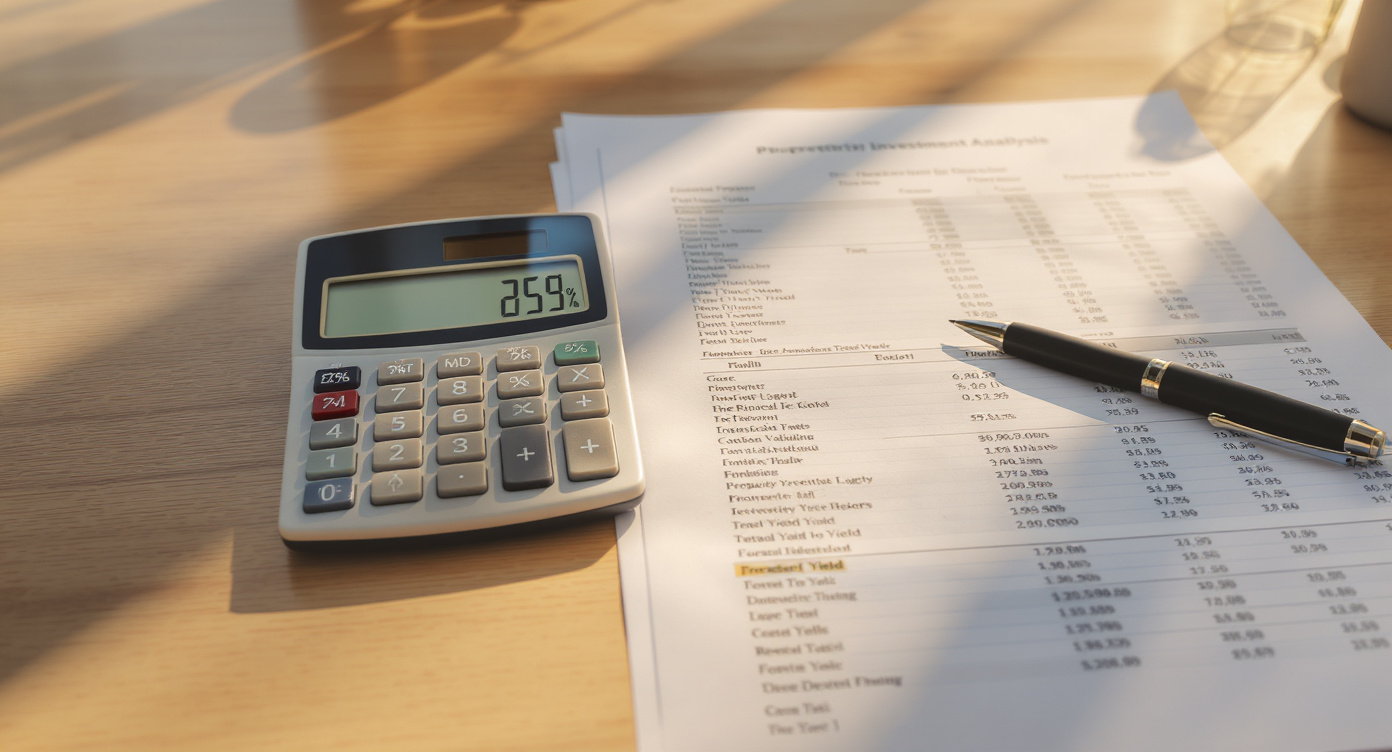
The short answer: A rental yield calculator divides annual rent by property value for gross yield, then subtracts expenses like rates, insurance, management fees, strata and vacancy for net yield, the figure that shows real cashflow. Capital city gross yields averaged 3.8% for houses and 4.3% for units in 2025 (CoreLogic), with regional markets often higher. Net yield, not gross, determines whether a property sustains itself.
Most Australian property investors check the price. They check the suburb. But when it comes to the rental yield calculator Australia investors should be using before every purchase, too many skip this step, and it costs them. Rental yield determines whether a property will drain your bank account every month or start building wealth from day one. It's the single most important number in your investment decision, yet it's routinely misunderstood, miscalculated, or ignored entirely. If you're weighing whether to buy where you want to live or invest where the numbers work, a rentvesting calculator models both scenarios side by side so you can see which path builds wealth faster.
A rental yield calculator Australia investors can trust doesn't just spit out a percentage. It shows you the real cashflow position, what the property earns versus what it costs to hold. Gross yield tells you the headline number. Net yield tells you the truth. The difference between the two is where most investment strategies fall apart. This article breaks down exactly how to calculate rental yield, what the numbers mean for your portfolio, which expenses to include, and what constitutes investment-grade yield in the current Australian market. If you're buying property to build wealth rather than just own bricks, these calculations aren't optional.
Rental yield is the annual rental income a property generates expressed as a percentage of its purchase price or current market value. It's the fundamental measure of how hard your capital is working. A rental yield calculator Australia investors use should answer one question: how much income does this property produce relative to what I'm paying for it? The formula itself is straightforward, annual rent divided by property value, multiplied by 100, but the variables you feed into that formula determine whether you're making a sound investment decision or setting yourself up for years of negative cashflow.
According to CoreLogic's 2025 rental yield analysis, Australian capital city gross yields averaged 3.8% for houses and 4.3% for units. Regional markets consistently delivered higher yields, with some mining and regional centres exceeding 7%. The gap between these numbers and what investors actually pocket after expenses is where strategy separates from speculation.
Gross rental yield is the simplest calculation: total annual rent divided by the property's value. If a property costs $600,000 and generates $28,000 in annual rent, the gross yield is 4.67%. This number appears in real estate listings, marketing materials, and preliminary investment assessments because it's clean, easy to compare, and looks better than the net figure. But gross yield ignores every cost of ownership, council rates, insurance, property management fees, maintenance, strata levies, and vacancy periods.
The formula: Gross Rental Yield = (Annual Rental Income ÷ Property Value) × 100.
Gross yield serves as a useful screening tool. It lets you compare properties quickly and filter out obviously low-performing assets. But making a purchase decision based solely on gross yield is like buying a business based on revenue without checking the expenses. The actual return, what you keep, requires the net calculation.
Net rental yield subtracts all operating expenses from the annual rent before dividing by the property value. This is the number that determines whether a property is positively cashflowed, negatively geared, or somewhere in between. A property with a 5% gross yield might deliver a 2.5% net yield after expenses, or even slip into negative territory if costs are high and vacancy rates are elevated.
The formula: Net Rental Yield = ((Annual Rental Income − Annual Expenses) ÷ Property Value) × 100.
Annual expenses include council rates, water rates, landlord insurance, property management fees (typically 6-8% of rent), strata fees for units, repairs and maintenance allowance, and vacancy loss. A rental yield calculator Australia investors rely on must account for vacancy, even a well-managed property averages 2-4 weeks vacant per year between tenancies. That's 4-8% of annual rent lost before you see a dollar.
'Net yield is the only number that tells you if the property can sustain itself,' says Michael Yardney, CEO of Metropole Property Strategists. 'Gross yield is marketing. Net yield is mathematics.'
A rental yield calculator Australia investors should use before signing a contract requires accurate inputs. Garbage in, garbage out. The quality of your yield calculation depends entirely on the quality of the data you feed it. That means verified rental appraisals, realistic expense estimates, and honest assumptions about vacancy and maintenance. Too many investors use optimistic rent figures from a selling agent's appraisal and underestimate expenses, then wonder why the property costs them $400 a month when the calculator showed it would be neutral. For a deeper look at how to isolate the headline figure before expenses enter the equation, a dedicated gross rental yield calculator walks through the screening process investors use to filter properties at first glance.
Research from the Property Investment Professionals of Australia (PIPA) found that 68% of first-time investors underestimated holding costs by at least 15%, leading to cashflow strain within the first 12 months. The solution is conservative modelling: use the lower end of the rental range, include every known expense, and add a 10% buffer for the costs you haven't thought of yet.
Start with a professional rental appraisal from a property manager who operates in the suburb. Not the selling agent's estimate, a dedicated rental appraisal from someone whose job is filling properties, not selling them. Request appraisals from two or three local property managers and use the middle figure, not the highest. Check current listings on realestate.com.au and domain.com.au for comparable properties in the same suburb, similar size, and condition. Filter by 'recently leased' to see actual outcomes, not asking prices.
For dual-key and triple-key properties, calculate each dwelling's rent separately. A dual-key property might generate $450 per week from the main dwelling and $320 per week from the attached unit, $770 combined, or $40,040 annually. That's the figure your rental yield calculator Australia analysis should use, not a single-dwelling estimate extrapolated across the property.
Every dollar you spend holding the property reduces net yield. Council rates vary by location but typically range from $1,200 to $2,500 annually. Water rates add another $800 to $1,200. Landlord insurance costs $400 to $800 per year depending on the property value and coverage level. Property management fees run 6-8% of gross rent, on $40,000 annual rent, that's $2,400 to $3,200. Strata levies for units average $3,000 to $6,000+ annually in metro areas.
Maintenance is the expense most investors underestimate. Industry rule of thumb: budget 1% of the property's value per year. On a $600,000 property, that's $6,000 annually, some years you'll spend less, some years a hot water system fails or a tenant damages carpet, and you'll spend more. The average evens out, but the cashflow impact in a bad year is real.
Vacancy loss is calculated as a percentage of potential rent. A property vacant for 3 weeks per year loses 5.8% of annual rent. On $40,000, that's $2,320 you never collect. Add it all up: council rates $1,800, water $1,000, insurance $600, management fees $2,800, strata $4,000, maintenance $6,000, vacancy $2,320. Total expenses: $18,520. On $40,000 gross rent and a $600,000 property value, gross yield is 6.67%. Net yield is 3.58%. That's the real number.
Investment-grade yield is not a fixed percentage, it's a function of location, property type, growth prospects, and the investor's strategy. A 3% net yield in inner Melbourne with strong capital growth fundamentals can be investment-grade. A 7% gross yield in a declining regional town with no employment diversity is not. The rental yield calculator Australia investors use should be paired with location analysis, not used in isolation.
According to SQM Research's December 2025 data, Sydney's median gross rental yield sat at 3.2% for houses and 3.9% for units. Melbourne delivered 3.4% for houses and 4.1% for units. Brisbane's stronger yield profile showed 4.2% for houses and 4.8% for units. Regional Queensland and regional Western Australia consistently outperformed capital cities, with yields in the 5-7% range common in areas with strong employment and infrastructure investment.
Capital cities trade yield for growth. Sydney and Melbourne properties historically deliver lower rental yields but stronger long-term capital appreciation. The trade-off works if you have the income and equity to absorb negative cashflow for a decade while waiting for price growth to compound. For most investors, particularly those building multi-property portfolios, that trade-off doesn't work, every dollar of negative cashflow reduces borrowing capacity for the next acquisition.
Regional markets deliver higher yields because property prices are lower relative to rents. A $400,000 house in regional Queensland generating $450 per week ($23,400 annually) delivers a 5.85% gross yield. The same $450 per week on an $800,000 Sydney house is 2.93%. The regional property is easier to cashflow, but the Sydney property might double in value faster. The right choice depends on your strategy, income, and portfolio stage. Understanding why the percentage matters more than the dollar price is central to portfolio strategy, which is exactly what a rental percentage yield calculator is designed to demonstrate.
Positive cashflow from day one requires net yields above a certain threshold. At 2026 interest rates (averaging 6-6.5% for investment loans), a property needs approximately 5.5-6% gross yield to achieve neutral or positive cashflow after all expenses and loan repayments. Dual-key properties generating 6-7% gross yields clear this threshold comfortably, which is why they form the foundation of Somerstone's portfolio construction approach.
Consider a $550,000 dual-key property generating $42,000 annual rent (7.6% gross yield). Assume $16,000 in annual expenses (net yield 4.7%). Loan amount $495,000 at 6.2% interest-only is $30,690 annual repayment. Rental income $42,000 minus expenses $16,000 minus loan repayment $30,690 equals negative $4,690. Add depreciation deductions of $12,000 in the first year (typical for new build), and the tax benefit at 37% marginal rate is $4,440. Net cost to the investor: $250 annually, or $21 per month. That's effectively neutral, and positive once depreciation is fully factored.
The alternative: a $550,000 standard house yielding 4% gross ($22,000 annual rent). After $14,000 expenses and the same loan repayment, the investor is $22,690 out of pocket annually before depreciation. That's $1,891 per month. One property builds a portfolio. The other prevents it.
The rental yield calculator Australia investors find online is only as good as the assumptions behind it. The most common mistakes: using optimistic rental estimates, underestimating expenses, ignoring vacancy, and failing to account for interest rate changes. Each error compounds. A 10% overestimate on rent plus a 20% underestimate on expenses can turn a property that looks neutral on paper into one that costs $400 a month in reality.
Data from PIPA's 2024 investor survey found that 43% of investors who experienced cashflow strain within the first two years had relied on rental estimates provided by the selling agent rather than independent appraisals. Another 38% had not included a maintenance buffer in their initial calculations, leading to unexpected out-of-pocket costs when repairs were needed.
Selling agents have an incentive to present properties in the best possible light. That includes rental appraisals. An agent might suggest a property will rent for $500 per week when the realistic market range is $450-$480. That $20-$50 difference is $1,040 to $2,600 annually, enough to turn a neutral property negative. Always verify rental estimates with independent property managers who have no stake in the sale.
Another trap: assuming the property will be tenanted 52 weeks per year. Even well-managed properties experience vacancy between tenancies. Budget for at least 2 weeks vacant per year (3.8% vacancy rate) as a baseline. Properties in high-turnover areas or lower-demand locations should assume 4-6 weeks (7.7-11.5%). A rental yield calculator Australia investors trust must include vacancy as a line item, not an afterthought.
First-time investors routinely underestimate the cost of ownership. Council rates, water, insurance, and strata fees are fixed annual costs that don't fluctuate with rent. Maintenance is variable but inevitable, budget 1% of the property value annually, and accept that some years will exceed that. Property management fees are 6-8% of gross rent in most markets, not the 5% some calculators assume by default.
Interest rate changes affect cashflow dramatically. A 1% increase in the interest rate on a $500,000 loan adds $5,000 to annual repayments, $417 per month. When modelling yield, stress-test the numbers at 1-2% above the current rate. If the property only works at today's rate, it's not a resilient investment. 'Model for the market you might get, not the market you hope for,' says Catherine Cashmore, property analyst at Cashmore & Co. 'Interest rates move. Your property still needs to perform.'
Ready to take the next step with Somerstone Property Group? Investors frustrated by residential yields below 4% often turn to commercial property investment in Australia, where net returns of 6–8% are standard and tenants typically cover outgoings.
Our team is ready to help you achieve your goals. Book a discovery call.
Rental yield is essential, but it's not the only metric that matters. A property with a 7% yield in a location with no population growth, declining employment, and oversupply is a yield trap, high income today, no capital growth tomorrow, and potentially falling rents as vacancy rises. Investment-grade properties balance yield, growth potential, and risk. The rental yield calculator Australia investors use should be the first filter, not the final decision.
The P.I.L.E. framework, Population, Infrastructure, Lifestyle, Employment, provides a structured way to assess whether a location has genuine underlying demand. A property in a location that scores well across those four factors has both rental demand (supporting yield) and buyer demand (supporting growth). Yield without growth leaves you stuck. Growth without yield leaves you broke. The right property delivers both.
Historically, Australian property investors have accepted lower yields in exchange for stronger capital growth. The logic: a property yielding 3% that doubles in value over 10 years delivers a better total return than a property yielding 6% that grows slowly. The problem with this approach is cashflow, low-yield properties require the investor to top up from their salary every month, which reduces borrowing capacity and limits portfolio size.
CoreLogic's 2025 analysis showed that Australian capital city property prices grew at a compound annual rate of 6.1% over the past 20 years, while regional areas grew at 5.3%. The yield differential between capital cities (3-4%) and regional markets (5-7%) has remained relatively stable. The optimal strategy for most investors: properties that deliver mid-tier yields (5-6% gross) in growth corridors with strong infrastructure investment and population inflow. These properties cashflow well enough to sustain themselves while still participating in capital appreciation.
A single property's yield matters. The combined cashflow position of a portfolio matters more. Three properties each costing $300 per month means $900 per month in top-up, $10,800 annually. That's a meaningful drag on lifestyle and borrowing capacity. Three properties each generating $200 per month positive cashflow means $600 per month income, $7,200 annually, that improves serviceability for property four.
The rental yield calculator Australia investors use for portfolio modelling should account for cumulative cashflow, not just individual properties. A portfolio of dual-key properties generating six rental incomes can achieve positive cashflow across the entire portfolio even if individual properties are only neutral. The combined effect is what determines whether you can keep buying or whether you're stuck at two properties because the bank won't lend you any more.
Rental yield is a pre-tax measure. The after-tax return, what you actually keep, depends on depreciation deductions, your marginal tax rate, and whether the property is positively or negatively geared. A property that costs $5,000 per year out of pocket before tax might only cost $1,500 after depreciation and tax benefits. That's still negative, but it's far more sustainable than the headline number suggests. Any rental yield calculator Australia investors use for serious decision-making must account for tax.
Depreciation is the decline in value of the building structure and fixtures over time, which the ATO allows you to claim as a tax deduction. For new-build properties, Division 43 (capital works) allows 2.5% of construction cost to be deducted annually over 40 years. Division 40 (plant and equipment) covers removable fixtures like carpet, blinds, and appliances, each depreciating at their own rate. A typical new dual-key property might generate $12,000 to $18,000 in first-year depreciation deductions.
Depreciation doesn't change the property's cashflow directly, it's a non-cash deduction. But it reduces your taxable income, which increases your tax refund or reduces your tax payable. On a $15,000 depreciation deduction at a 37% marginal tax rate, the tax benefit is $5,550. That $5,550 goes back into your pocket, offsetting the property's holding costs. Regional yield profiles vary significantly by state and city, and the property market in Perth has delivered some of the strongest rental returns in the country as vacancy rates tightened through 2025.
Consider a property with $3,000 annual negative cashflow before depreciation. Add $15,000 in depreciation deductions. Total tax loss is $18,000. At 37% marginal rate, the tax refund is $6,660. The property's after-tax position is positive $3,660. The rental yield calculator Australia investors use should include a depreciation field and a marginal tax rate input to show the after-tax outcome, not just the pre-tax cashflow.
Only properties built after 1985 can claim Division 43 capital works deductions. Properties built after 9 May 2017 lose the ability to claim Division 40 plant and equipment depreciation if purchased second-hand, only the original owner can claim it. This means new-build properties deliver the maximum available depreciation, while established properties deliver far less or none at all.
A new dual-key property with $350,000 in construction cost generates approximately $8,750 annually in Division 43 deductions (2.5% of $350,000) plus $6,000 to $10,000 in Division 40 deductions in the early years. An established property purchased for the same price might generate $2,000 to $4,000 in deductions, or zero if it's older than 40 years. Over a 10-year hold, the cumulative difference is $50,000 to $80,000 in deductions, representing $18,500 to $29,600 in tax savings at a 37% rate. That's real money that directly improves the investment's return.
A rental yield calculator Australia investors can rely on is the foundation of every sound property decision. Gross yield filters opportunities. Net yield reveals the truth. After-tax cashflow determines what you actually keep. The right property delivers strong yield and growth potential in a location with genuine demand fundamentals, population, infrastructure, lifestyle, and employment all aligned. The wrong property looks good on a spreadsheet but costs you every month and limits your ability to build a portfolio.
The difference between a 4% yield and a 6% yield on a $600,000 property is $12,000 per year. Over 10 years, that's $120,000 in rental income, enough to fund the deposit on another property. Yield compounds. Cashflow enables growth. Strategy determines outcomes. If you're serious about building wealth through property, the rental yield calculator Australia provides the numbers, but you provide the strategy.
A good rental yield depends on location and strategy. Capital cities average 3-4% gross yield, while regional markets deliver 5-7%. For positive cashflow strategies, target 5.5-6% gross yield minimum. Investment-grade properties balance yield with capital growth potential, high yield in a declining market is not a good investment.
Net rental yield is annual rent minus all expenses, divided by property value, multiplied by 100. Include council rates, water, insurance, property management fees (6-8%), strata, maintenance (1% of value), and vacancy loss (2-4 weeks annually). Use a rental yield calculator Australia investors trust, with conservative expense estimates, not optimistic ones.
Use gross yield for initial screening and quick comparisons. Use net yield for final decisions. Gross yield is the headline number. Net yield is the truth. A property with 6% gross yield and high expenses might deliver worse net yield than a property with 5% gross and low expenses. Always calculate both before committing.
No. Rental yield is calculated using actual cashflow, rent minus expenses. Depreciation is a tax deduction, not a cashflow item. However, depreciation considerably improves after-tax return. A property with 3% net yield and $15,000 annual depreciation might be cash-positive after tax. Model both pre-tax and after-tax positions for accurate assessment.
Technically yes, but practically difficult. Low-yield properties require ongoing top-up from your salary, which reduces borrowing capacity for subsequent purchases. Most investors get stuck at one or two negatively geared properties. High-yield, positively cashflowed properties preserve serviceability, enabling faster portfolio growth. Yield determines how many properties you can hold, not just how much each one costs.
