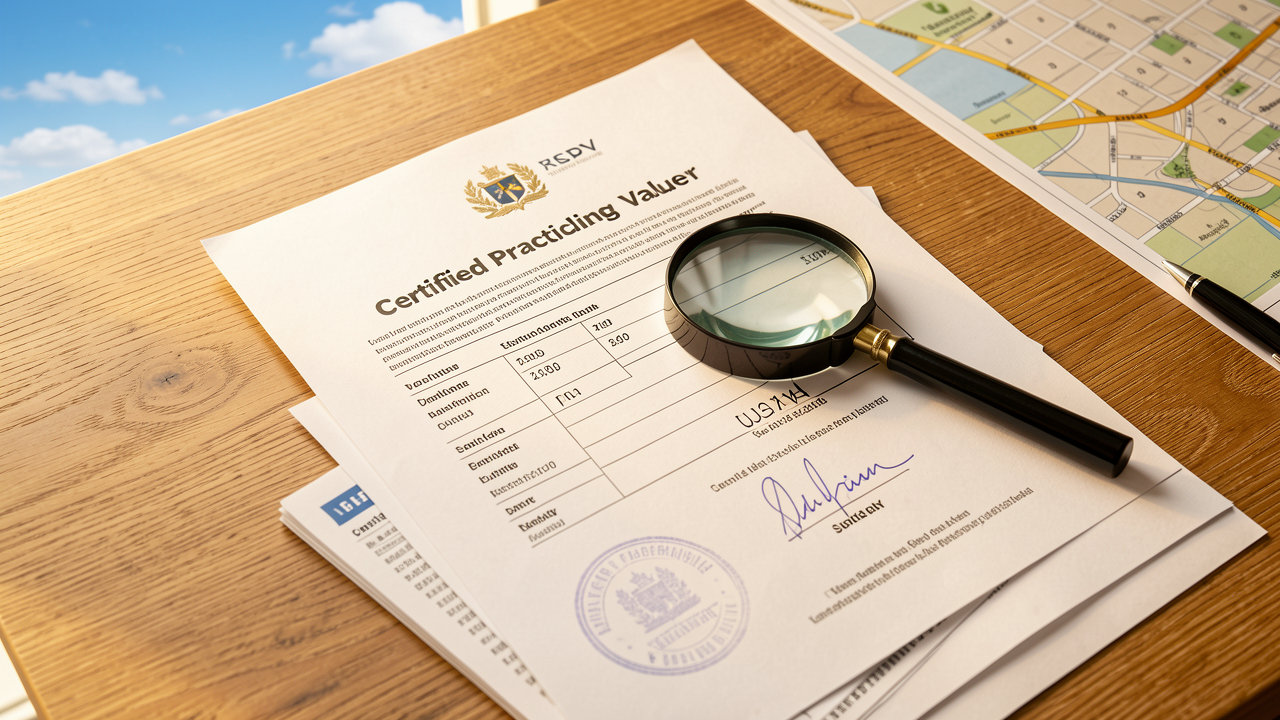
The short answer: Property valuation Sydney refers to the professional assessment of a property's market worth or statutory land value. You'll need a formal valuation for mortgage refinancing, family law settlements, probate, tax advice or sale negotiations. NSW land values are free via the Valuer General portal, but a full market appraisal requires a Certified Practising Valuer who inspects the property and analyses comparable sales. Many Sydney buyers use accurate valuations to confirm they're paying fair market value for an investment property while continuing to rent in a suburb they prefer, a strategy known as rentvesting.
Understanding property valuation Sydney matters whether you're refinancing, settling an estate, or preparing to sell. The figure on a valuation report shapes loan approvals, tax calculations, and negotiation outcomes. Yet many property owners confuse a government land value with a market appraisal, or assume an online estimate carries the same weight as a sworn valuation report.
A property valuation Sydney is a professional opinion of a property's worth at a specific date. That opinion can take several forms depending on who prepares it and what purpose it serves.
Market value is what a willing buyer would pay a willing seller in an open transaction. A Certified Practising Valuer inspects the property, reviews recent comparable sales, and issues a formal report stating the market value as at the inspection date. This report is accepted by lenders, courts, and the Australian Taxation Office.
Land value is the statutory figure set by the NSW Valuer General for rating and land tax purposes. It represents the unimproved value of the land only, excluding buildings and other improvements. According to the NSW Valuer General portal, land values are updated annually and published on 1 July each year. You can search your land value for free at valuation.property.nsw.gov.au.
An automated valuation estimate is a computer-generated price range produced by data platforms using sales history, suburb trends, and property attributes. These estimates are useful for a quick indicative range but lack the inspection, adjustment, and reasoning that underpin a formal valuation report.
The distinction matters because a land value of $800,000 does not mean your house and land together are worth $800,000. The improved property might be worth $1.4 million. Conversely, an online estimate of $1.2 million is not a sworn valuation and won't satisfy a lender or a court.
Formal valuations are required in specific situations. Mortgage refinancing is the most common trigger. Lenders order a valuation to confirm the property secures the proposed loan amount. Family law property settlements require independent valuations so both parties negotiate from an agreed figure. Probate and deceased estates need valuations to calculate capital gains tax and distribute assets fairly.
Capital gains tax advice relies on a valuation at the date of acquisition or the date an investment property became your main residence. Stamp duty disputes may require a valuation if you believe the purchase price was inflated or the property's condition has changed. Litigation, compensation claims, and compulsory acquisition all demand sworn valuation evidence.
Pre-purchase due diligence sometimes includes a valuation to confirm you're not overpaying, particularly if the property is unusual, has defects, or sits in a thinly traded suburb where comparable sales are scarce.
| Valuation Type | What It Is | Primary Use |
|---|---|---|
| Market valuation report | Sworn opinion by Certified Practising Valuer | Lending, family law, probate, tax |
| NSW land value | Statutory unimproved land value | Council rates, land tax assessment |
| Agent's appraisal | Comparative market analysis by real estate agent | Sale preparation, indicative pricing |
| Automated estimate | Algorithm-generated price range | Initial research, curiosity |
Valuers use three core methods depending on property type and purpose. The comparable sales method dominates residential property valuation Sydney. The valuer identifies recent sales of similar properties in the same suburb, adjusts for differences in size, condition, location, and timing, then arrives at a market value.
Comparable sales are the foundation. A valuer selects three to six recent transactions of properties similar in type, size, age, and location. If you own a three-bedroom brick house in Marrickville, the valuer looks at other three-bedroom brick houses sold in Marrickville within the past three to six months.
Adjustments are then applied. If a comparable property has a larger land area, the valuer adjusts downward to reflect your smaller block. If your property has been renovated and the comparable has not, the valuer adjusts upward. Adjustments account for views, parking, street appeal, internal condition, and any defects or improvements. Transport access and school catchments are two of the strongest location drivers, and these factors play out differently across Sydney property investment suburbs depending on infrastructure timing and zoning changes.
The valuer weights the adjusted comparables and arrives at a final figure. This process is transparent in a formal report. You see the comparables, the adjustments, and the reasoning. An online estimate skips the inspection and applies broad statistical adjustments, which is why it can miss renovations, defects, or unique features.
Data from CoreLogic (now Cotality) shows Sydney's median house price reached $1,395,000 in December 2025, while the median unit price sat at $785,000. These suburb-level and property-type variations mean a valuer must select comparables carefully to reflect the specific market segment.
The summation approach values land and improvements separately, then adds them together. This method suits properties where comparable sales are scarce or where the land value dominates. A valuer estimates the land value using vacant-land sales, then adds the depreciated replacement cost of the building.
The income approach capitalises net rental income to estimate value. It's used for investment properties, commercial premises, and specialised assets where income is the primary driver. A property generating $50,000 net annual rent might be valued by applying a capitalisation rate of 4%, producing a value of $1,250,000.
For development sites, the valuer considers the highest and best use. A single house on a large block zoned for dual occupancy or townhouses may be valued based on its development potential rather than its current use. The valuer estimates the end value of the completed development, deducts construction costs, holding costs, profit, and risk, and arrives at the site value.
Property valuation Sydney is shaped by factors specific to the property and factors tied to its location. Understanding both helps you interpret a valuation report and identify opportunities to improve value before sale or refinancing.
Land size, frontage, and topography matter enormously. A 600-square-metre block with a 15-metre frontage in a suburb zoned for dual occupancy commands a premium over a 400-square-metre block with a 10-metre frontage. Level land is worth more than steep or irregular blocks that limit usable space or increase construction costs.
Internal floor area and layout drive value for houses and units. A 150-square-metre house with four bedrooms and two bathrooms appeals to a broader buyer pool than a 120-square-metre house with three bedrooms and one bathroom. Practical layouts with separate living zones, good natural light, and minimal wasted hallway space add value.
Renovation quality, defects, and deferred maintenance are adjusted in the valuation. A recently renovated kitchen and bathroom can add $50,000 to $100,000 to a house's value in a mid-tier Sydney suburb. Conversely, a property with rising damp, cracked render, or an aging roof will be discounted to reflect the cost of repairs.
Heritage restrictions, easements, flooding, and bushfire exposure reduce value or limit buyer appeal. A heritage-listed property in the Inner West may attract premium buyers but also carries higher maintenance costs and council approval complexity. A property in a flood-prone area requires disclosure and may face higher insurance premiums, which buyers factor into their offers.
School catchments are one of the most powerful location drivers. Properties within the catchment of a selective high school or a well-regarded public primary school command premiums of 10% to 20% over comparable properties outside the zone. Research from the NSW Department of Education confirms that catchment boundaries directly influence buyer demand and sale prices.
Transport access shapes value across Sydney. Properties within 800 metres of a train station, metro stop, or frequent bus route attract higher prices and stronger rental demand. The opening of the Sydney Metro in 2024 lifted values in suburbs along the new line, with properties near Waterloo, Sydenham, and Marrickville stations seeing price growth above the Sydney median.
Walkability and retail amenities matter. A property within a five-minute walk of cafes, supermarkets, parks, and services appeals to a broader buyer pool than a property requiring a car for every errand. Noise, aircraft paths, major roads, and industrial uses reduce value. A house under the Sydney Airport flight path or adjacent to a busy arterial road will be discounted compared to a quieter street in the same suburb. A formal valuation report gives you the evidence you need to negotiate confidently when buying an investment property in Sydney, particularly if the asking price sits above recent comparable sales.
Harbour, beach, park, and district views add large value. A north-facing apartment in Mosman with harbour views can be worth double a comparable apartment without views. Even partial or district views from an elevated position add 5% to 15% to value.
If you're building a property portfolio and want to understand how valuation, equity position, and borrowing capacity interact across multiple assets, book a discovery call to explore how strategic property selection shapes long-term wealth outcomes.
Property valuation Sydney varies greatly by property type. The valuation method, comparable selection, and value drivers differ between a detached house, a strata apartment, and a development site.
Detached houses on Torrens title are valued primarily on land size, location, and the quality of the dwelling. In suburbs where land is scarce and demand is strong, the land component dominates. A modest house on a large block in Balmain may be worth more than a renovated house on a small block in the same suburb because the larger block offers redevelopment potential.
Torrens-title townhouses are valued similarly to houses but with adjustments for shared driveways, smaller land areas, and sometimes restrictive covenants. A three-bedroom townhouse in Newtown on a 200-square-metre lot will be valued against other townhouses in the area, not against detached houses on 400-square-metre blocks.
Duplexes and dual-occupancy properties are valued based on their income potential and the combined land value. A duplex generating two rental incomes on a single title in a high-demand suburb like Parramatta or Ryde will be valued using both the comparable sales method and an income approach to reflect the investment appeal.
Strata apartments are valued on internal floor area, aspect, views, parking, storage, building quality, and strata levies. A two-bedroom apartment in a well-maintained building with low levies, secure parking, and north-facing living areas will be valued higher than a similar-sized apartment in a building with high levies, deferred maintenance, or no parking.
Strata reports matter. A valuer reviews the strata plan, levy notices, meeting minutes, and any special levies or building defects. A building with a major works levy of $50,000 per unit will see values discounted to reflect that liability. Conversely, a building with a healthy sinking fund and recent facade or lift upgrades will be valued more favourably.
Aspect and floor level drive value in apartment buildings. A top-floor apartment with harbour glimpses and no units above will command a premium over a ground-floor unit facing a courtyard. The difference can be 20% to 30% in premium buildings.
Ready to take the next step with Somerstone Property Group?
Our team is ready to help you achieve your goals. Book a discovery call.
Not all valuations carry the same weight. The credentials of the person preparing the report, the purpose of the valuation, and the methodology used all determine whether the report will be accepted by a lender, a court, or the ATO.
A Certified Practising Valuer (CPV) is a professional recognised by the Australian Property Institute. CPVs hold formal qualifications, maintain professional indemnity insurance, and adhere to the API's code of conduct and valuation standards. A valuation prepared by a CPV is accepted by lenders, courts, and government agencies.
Lender-appointed valuers are typically CPVs engaged by the bank to assess security for a loan. The borrower pays the fee but does not receive a copy of the full report unless they request it. The valuation is prepared for the lender's benefit, not the borrower's, and may be conservative to protect the bank's security position. Understanding how valuers weight land size, income potential, and development upside helps you identify the best property investment structure for your portfolio and borrowing capacity.
Real estate agents prepare comparative market appraisals (CMAs) to help sellers set asking prices. A CMA is not a formal valuation and is not accepted for lending, legal, or tax purposes. It's a useful starting point for understanding market conditions but lacks the inspection rigour and sworn opinion of a CPV report.
Automated valuation models (AVMs) are produced by data platforms using algorithms and historical sales data. They're fast and free but cannot account for renovations, defects, views, or unique property characteristics. An AVM might estimate a property at $1.1 million when a CPV inspection reveals $80,000 in deferred maintenance, adjusting the value to $1.02 million.
Preparation improves the accuracy and outcome of a valuation. Gather title documents, contracts, and any records of renovations, extensions, or improvements. Provide dates and costs where possible. If you've replaced the roof, upgraded the kitchen, or added a deck, the valuer needs to know.
Provide renovation approvals, leases, and strata records. If you've completed work without council approval, disclose it. The valuer will identify unapproved work during the inspection, and non-disclosure undermines your credibility. For investment properties, provide current lease agreements, rental statements, and any tenant correspondence.
Disclose defects rather than relying on presentation alone. A fresh coat of paint won't hide structural cracks, water damage, or pest issues. A valuer is trained to identify defects, and attempting to conceal them only delays the inevitable adjustment in the report.
Ensure the valuer can inspect all relevant areas. Unlock sheds, garages, and roof spaces. If the property has a granny flat, dual-key dwelling, or separate studio, ensure access is available. A valuer who cannot inspect the full property will note the limitation in the report, which may affect the lender's decision.
For investors building a portfolio, understanding how property valuation Sydney interacts with equity position and borrowing capacity is critical. Somerstone Property Group's Premium Investment Concierge model includes strategic analysis of how each property's valuation affects your ability to acquire the next one, ensuring your portfolio construction is based on real numbers, not assumptions.
The NSW Valuer General provides free access to land values, sales evidence, and an online objection process. Understanding how to use the portal and when to challenge a land value can save thousands in land tax and rates.
The NSW Valuer General portal at valuation.property.nsw.gov.au allows you to search your property's land value, view comparable sales used in the valuation, and lodge an objection if you believe the value is incorrect. Land values are updated annually and published on 1 July. The portal was last updated on 22 October 2024.
To search your land value, enter your property address or lot and DP number. The portal displays the current land value, the previous year's value, and the percentage change. You can also view a valuation sales report showing the comparable sales the Valuer General used to determine your land value.
The land value is not the same as the market value of your house and land together. Land value represents the unimproved value of the land only, excluding buildings, landscaping, and other improvements. If your land value is $900,000, your house and land together might be worth $1.5 million.
Land values are used to calculate council rates and land tax. If your land value increases, your rates and land tax may increase. If you believe the land value is too high, you have 60 days from the date of the notice to lodge an objection through the portal.
You should object if you believe the land value does not reflect the market value of similar vacant land in your area. Common grounds for objection include incorrect property details (wrong land size, zoning, or development potential), inappropriate comparable sales (sales from a different suburb, sales of improved properties rather than vacant land, or sales that occurred outside the valuation period), or market conditions that the Valuer General did not adequately reflect. While a valuation report states a formal opinion of market value at a specific date, the actual property price you negotiate depends on buyer competition, vendor motivation, and how well you interpret the underlying value drivers.
To lodge an objection, log in to the portal, select your property, and complete the online objection form. Provide evidence to support your objection, such as recent sales of comparable vacant land, a valuation report from a CPV, or documentation of property constraints (flooding, contamination, easements, or heritage restrictions).
The Valuer General reviews your objection and either confirms the land value, reduces it, or requests further information. If the objection is successful, your land value is adjusted and your rates and land tax are recalculated. If the objection is rejected, you can request a formal review or appeal to the Land and Environment Court.
The objection process is free and can be completed online. If you're unsure whether to object, compare your land value to neighbouring properties of similar size and zoning. If your land value is greatly higher without an obvious reason, an objection is worth lodging.
Property valuation Sydney is not a single number or a one-size-fits-all process. The figure you need depends on the purpose: a formal CPV report for lending or legal matters, a free NSW land value for rates and tax, or an agent's appraisal for sale preparation. Each serves a different function and carries different weight.
Understanding how valuers calculate market value, what drives property worth across Sydney's diverse suburbs, and when to challenge a government land value puts you in control of the process. Preparation matters. Gather documents, disclose defects, and ensure the valuer can inspect the full property. The more transparent you are, the more accurate the valuation.
If you're building a property portfolio, valuation is not just about what a property is worth today. It's about how that value unlocks equity for the next purchase, how the rental income supports borrowing capacity, and how the asset fits into a 10-year wealth strategy. Get the valuation right, and the rest of the portfolio construction follows.
A property valuation Sydney prepared by a Certified Practising Valuer is a sworn opinion accepted by lenders, courts, and the ATO. An agent's appraisal is a comparative market analysis used for sale preparation and is not accepted for legal or lending purposes.
Fees vary by property type, location, and report purpose. A standard residential valuation for a house or unit typically costs $400 to $800. Complex properties, urgent turnaround, or court-ready reports cost more. Always confirm the fee and scope before ordering.
Online estimates are useful for initial research but lack inspection, adjustment, and sworn opinion. Lenders, courts, and the ATO do not accept automated estimates. If you need a valuation for refinancing, family law, or probate, you must engage a Certified Practising Valuer.
Compare your land value to neighbouring properties of similar size and zoning using the NSW Valuer General portal. If your land value is considerably higher without an obvious reason, review the comparable sales in your valuation sales report and consider lodging an objection within 60 days.
Building a portfolio requires understanding how each property's valuation affects equity position, borrowing capacity, and cashflow. You need strategic modelling that accounts for rental income, depreciation, and lender serviceability tests. Most investors lack the time or expertise to manage this across multiple properties, which is why professional portfolio construction services exist.
