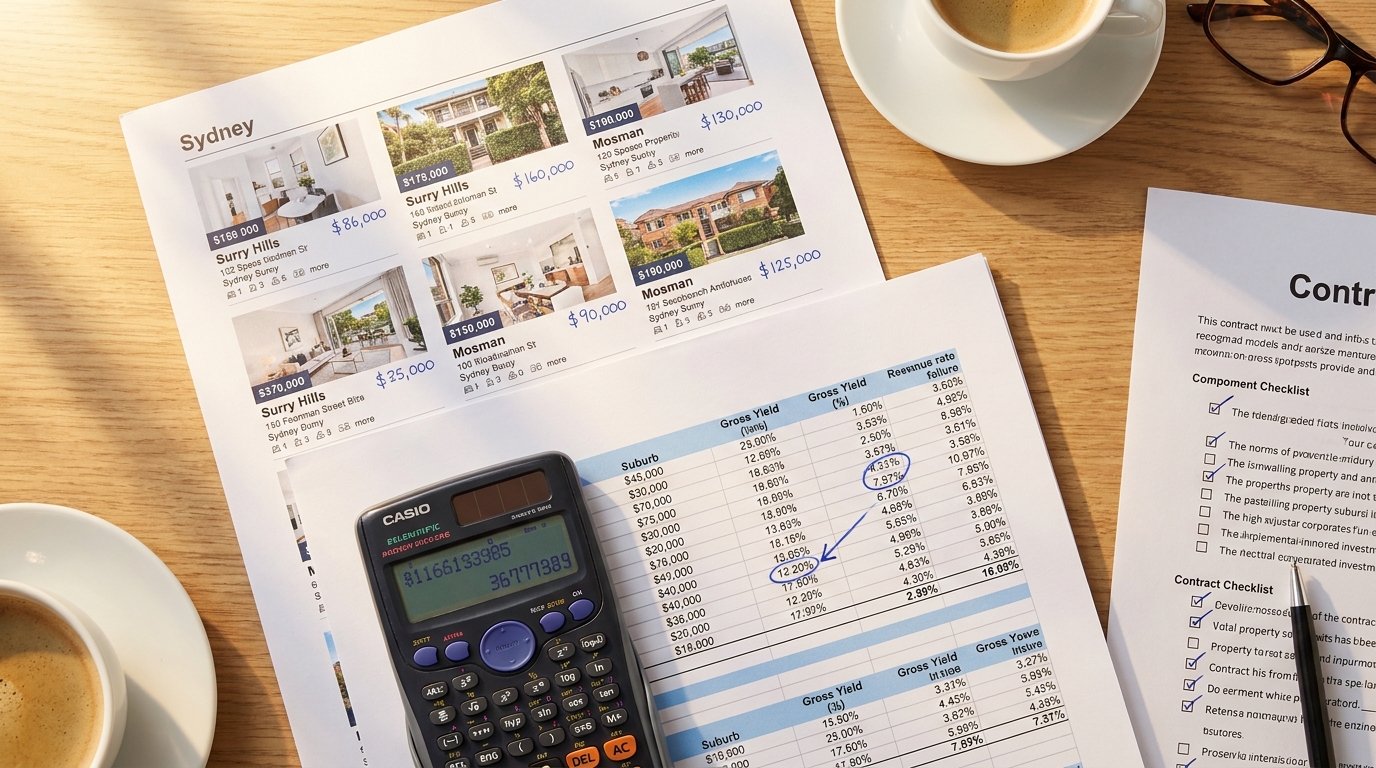
The short answer: Buying an investment property in Sydney in 2026 means accepting median house prices near $1,338,000 and gross yields of 2.8-3.5%, often negatively geared by $10,000-$20,000+ annually. Investors accept this for long-term capital growth averaging 6-7% a year. Structuring for cashflow, such as dual-key properties yielding 6-7% gross, can reduce holding costs and preserve borrowing capacity for future purchases.
Buying an investment property Sydney in 2026 means navigating Australia's most expensive residential market with some of its lowest rental yields, yet investors continue to pour capital into the harbour city. The question isn't whether Sydney property remains viable, but whether your strategy can withstand median house prices above $1.3 million and gross yields hovering around 3%. The math has to work, or you're merely speculating with borrowed money. For investors priced out of Sydney's premium suburbs where they want to live, a rentvesting calculator models the financial trade-offs between renting in a desirable location while investing in a higher-yield market.
Sydney's enduring appeal rests on three pillars: consistent long-term capital growth averaging 6-7% annually over multi-decade periods, strong population growth driven by immigration and interstate migration, and a diversified economy that supports employment across finance, technology, healthcare, and professional services. But these fundamentals don't guarantee your individual investment will succeed. Strategy determines outcome, not location alone.
This article examines the structural realities of buying an investment property Sydney in 2026: what drives investors to commit despite high entry costs, how to construct a financially sustainable acquisition, where growth and yield intersect across the metro area, and what pitfalls separate profitable portfolios from overleveraged disasters. If you're evaluating Sydney as an investment destination, you need more than optimism. You need numbers that close.
The paradox of Sydney property investment is straightforward: it's expensive, yields are low, and investors keep buying. CoreLogic data shows Sydney's median house price reached $1,338,000 in late 2025, with units at $745,000. Gross rental yields for houses sit between 2.8-3.5% across most suburbs, meaning a $1.2 million house generating $40,000 annual rent delivers just 3.3% before any expenses. After mortgage interest, council rates, insurance, property management, and maintenance, most Sydney properties are negatively geared by $10,000-$20,000+ annually.
So why do high-income professionals continue buying an investment property Sydney when regional markets offer 5-6% yields and lower purchase prices? The answer is capital growth expectation and risk appetite. Investors betting on Sydney are trading current cashflow for future equity. Historical data supports this: Sydney property has doubled roughly every 10-12 years since the 1980s, delivering cumulative returns that dwarf the annual holding costs. A property purchased for $600,000 in 2013 that appreciated to $1.2 million by 2023 generated $600,000 in equity, far exceeding a decade of negative gearing costs.
Sydney's capital growth thesis rests on supply constraints and demand persistence. The Greater Sydney region adds approximately 100,000 residents annually through net overseas migration and interstate arrivals, yet housing supply consistently lags demand. The NSW Department of Planning targets 40,000+ new dwellings per year, but approvals, construction timelines, and land availability mean actual delivery falls short. This structural undersupply supports price growth even during economic downturns.
Research from Domain shows inner-ring suburbs within 10km of the CBD have delivered average annual growth of 6.8% over 20-year periods, outperforming outer suburbs (5.2%) and regional NSW (4.9%). Investors buying an investment property Sydney in established, well-located areas are banking on this pattern continuing. The trade-off is accepting years of negative cashflow in exchange for equity accumulation that eventually exceeds the cumulative holding costs. For investors on high marginal tax rates (37-45%), negative gearing provides partial tax relief, effectively reducing the annual out-of-pocket cost.
Negative gearing remains a primary motivation for Sydney investors. When an investment property's deductible expenses (mortgage interest, depreciation, management fees, repairs) exceed its rental income, the loss offsets the investor's other taxable income. On a $45,000 annual loss, an investor on a 45% marginal rate receives approximately $20,250 back via reduced tax liability. This doesn't eliminate the loss, but it subsidises the holding cost while equity builds.
Depreciation schedules on new-build properties amplify this effect. A new dual-key property with $350,000 in construction costs might generate $18,000 in first-year depreciation deductions, a non-cash deduction that reduces taxable income without requiring actual expenditure. Over five years, cumulative depreciation of $60,000+ translates to $22,000-$27,000 in tax savings for high-income earners. This tax structure makes Sydney investment viable for professionals earning $150,000+ who can absorb short-term cashflow deficits in exchange for long-term wealth accumulation.
The biggest mistake investors make when buying an investment property Sydney is underestimating ongoing costs and overestimating rental income. A property purchased for $900,000 with a 10% deposit ($90,000) and a $810,000 loan at 6.5% interest generates $52,650 annual interest expense. Add $2,500 council rates, $1,200 insurance, $2,800 property management (7% of $40,000 rent), $2,000 maintenance allowance, and $1,500 strata (for units), and total annual costs hit $62,650. Against $40,000 rental income, that's a $22,650 annual shortfall, $1,887 per month out of pocket.
This cashflow drain directly impacts borrowing capacity for future investments. Lenders assess serviceability by calculating net rental income (rent minus expenses) and adding it to your salary. A negatively geared property reduces your effective income, constraining how much you can borrow for property two. This is why buying an investment property Sydney often becomes a one-and-done scenario for investors who don't structure for cashflow sustainability. The decision between investment property vs shares hinges on leverage, tax treatment, and risk tolerance, factors that make direct comparison more nuanced than simple return percentages suggest.
The RBA's rate-hiking cycle from 2022-2024 reshaped investment property economics. Variable rates that sat at 2.5% in 2021 climbed to 6.5%+ by 2024, adding $32,000 annually to a $800,000 loan. Investors who purchased during the low-rate environment suddenly faced doubled holding costs. According to Australian Prudential Regulation Authority (APRA) data, investor loan approvals dropped 28% from 2021 peaks as serviceability tightened.
Lenders now stress-test loans at 3% above the actual interest rate to ensure borrowers can withstand further increases. A loan at 6.5% is assessed at 9.5% serviceability. This buffer protects lenders but dramatically reduces how much investors can borrow. For a household earning $180,000 annually with $50,000 in existing debts (mortgage, car loan, credit cards), maximum borrowing capacity might be $650,000-$750,000, barely enough for a median Sydney property once deposit and stamp duty are factored in.
Achieving positive cashflow when buying an investment property Sydney requires structural solutions, not wishful thinking. Dual-key and triple-key properties, single-title dwellings containing two or three self-contained residences, generate multiple rental income streams that fundamentally alter the yield equation. A $750,000 dual-key property with a three-bedroom house plus a two-bedroom attached dwelling might generate $55,000 combined annual rent (7.3% gross yield) versus $28,000 (3.7%) for a standard house at the same price.
That yield differential changes everything. Higher rental income means lower or eliminated negative gearing, which preserves borrowing capacity and enables portfolio expansion. Somerstone Property Group's Premium Investment Concierge model sources these dual-key and triple-key opportunities across Victoria, New South Wales, and Queensland, focusing on new-build properties that deliver 6-7% gross yields while maintaining capital growth potential. The strategy prioritises cashflow sustainability over speculative growth, properties that support themselves rather than drain the investor's salary.
Location selection when buying an investment property Sydney determines whether your strategy succeeds or stalls. The Sydney metro area encompasses 658 suburbs across 12,368 square kilometres, not all locations offer equivalent investment fundamentals. Investors chasing premium inner-city suburbs (Bondi, Mosman, Balmain) face entry prices above $2 million with yields below 3%. Those targeting outer-growth corridors (Marsden Park, Leppington, Oran Park) find lower prices but higher vacancy risk and slower capital appreciation.
The optimal investment zone sits in the middle: established suburbs 15-30km from the CBD with strong infrastructure, diverse employment, and median prices between $800,000-$1.2 million. SQM Research data shows suburbs in this band, including Parramatta, Blacktown, Liverpool, Campbelltown, and parts of the Inner West, deliver 4-5% gross yields while maintaining capital growth rates of 5-6% annually. These areas benefit from government infrastructure investment (WestConnex, Sydney Metro, Western Sydney Airport) that improves connectivity and supports population growth.
Effective suburb selection requires systematic evaluation, not gut feel. The P.I.L.E. framework assesses four critical factors: Population growth (is the area adding residents through migration and new housing?), Infrastructure investment (are governments and private sector building transport, schools, hospitals?), Lifestyle amenity (does the area offer services, recreation, and quality of living that attracts tenants?), and Employment diversity (are there multiple industries and employers, or reliance on a single sector?).
Consider Parramatta: population growth of 2.8% annually (Australian Bureau of Statistics), $20+ billion infrastructure pipeline including Sydney Metro West and Parramatta Light Rail, lifestyle amenity with Westfield shopping, riverside dining, and cultural precincts, and employment diversity across health (Westmead Hospital precinct), education (Western Sydney University), government (NSW Department offices), and corporate (CommBank, NAB). A suburb scoring well across all four P.I.L.E. factors has genuine underlying demand that supports both rental income stability and long-term price appreciation.
The classic trade-off in Sydney property investment is yield versus growth. Inner suburbs deliver strong capital growth but weak yields. Outer suburbs offer better yields but slower growth. The strategic solution is portfolio diversification, combining properties with different risk-return profiles. An investor buying an investment property Sydney might pair a high-growth inner-west unit (3% yield, 7% growth) with a dual-key property in a growth corridor (6% yield, 5% growth). The blended portfolio delivers both income and equity accumulation. Whether property a good investment in Australia depends on your capacity to absorb holding costs while waiting for capital growth to compound over decades, not years.
Data from Propertyology shows investors holding diversified portfolios across multiple suburbs and property types outperform single-property investors by 18-24% over 10-year periods. Diversification reduces concentration risk, if one suburb underperforms due to local economic shifts or oversupply, other holdings compensate. It also balances cashflow: the high-yield property subsidises the negative gearing on the growth property, creating a more sustainable overall position. This requires upfront planning and sufficient equity to acquire multiple properties, but the compounding effect accelerates wealth creation substantially.
Buying an investment property Sydney involves a structured process that separates successful investors from those who stumble into poor purchases. The sequence matters: attempting to buy before securing finance approval, skipping due diligence, or rushing into contracts without proper legal review creates financial risk and legal exposure. The correct process protects capital and ensures the property you purchase matches your strategy.
Step one is financial assessment and loan pre-approval. Before viewing a single property, engage a mortgage broker to calculate your borrowing capacity based on income, existing debts, and the rental income from the proposed investment. Lenders assess investment loans differently than owner-occupied mortgages, rental income is typically shaded by 20% to account for vacancy and management costs. Understanding your maximum borrowing capacity and the deposit required (typically 20% to avoid Lenders Mortgage Insurance) establishes your search parameters.
Once pre-approved, the property search begins. For Sydney investors, this means defining target suburbs using the P.I.L.E. framework, setting yield and price parameters, and deciding between established properties (houses, older units) and new builds (apartments, dual-key, townhouses). Established properties offer immediate rental income and potentially lower purchase prices but come with maintenance obligations and limited depreciation. New builds deliver maximum tax deductions through depreciation, builder warranties, and modern design but may carry higher price premiums and slower initial capital growth.
Due diligence on shortlisted properties includes: building and pest inspections (for houses and older units), strata report review (for units and townhouses, examining financial health, maintenance history, and upcoming levies), contract review by a solicitor or conveyancer, rental appraisal from a local property manager to verify expected income, and comparable sales analysis to confirm the asking price reflects market value. Skipping any of these steps exposes the investor to hidden defects, financial liabilities, or overpayment. According to Australian Property Institute data, investors who conduct full due diligence avoid 78% of post-purchase disputes and unexpected costs.
Once due diligence confirms the property meets investment criteria, the offer and contract process begins. In NSW, buyers typically have a 5-business-day cooling-off period after exchanging contracts (unless purchasing at auction, where cooling-off does not apply). During this period, the buyer can withdraw with a 0.25% penalty of the purchase price. After cooling-off expires, the contract becomes unconditional and both parties are legally bound to settle.
Settlement occurs 30-90 days after exchange (timeframe negotiated in the contract). During this period, the buyer finalises loan approval, arranges property insurance, engages a property manager to find tenants, and coordinates with their solicitor to ensure all legal and financial requirements are met. At settlement, ownership transfers, the loan funds are released to the seller, and the buyer receives the keys. For investors buying an investment property Sydney, settlement day marks the beginning of the asset's performance period, from this point forward, the property must deliver the rental yield and capital growth that justified the purchase.
Ready to take the next step with Somerstone Property Group? The fundamentals that determine whether an investment property buy builds wealth or drains cashflow apply universally, but Sydney's premium pricing amplifies both the risks and the stakes.
Our team is ready to help you achieve your goals. Book a discovery call.
Ownership begins at settlement, but wealth creation depends on active management and performance monitoring. An investment property is a business asset, not a passive savings account. It requires tenant management, maintenance coordination, financial record-keeping, tax compliance, and periodic performance review to ensure it continues serving the investment strategy. Investors who treat property as a "set and forget" asset often discover years later that poor management has eroded returns.
The first decision is property management: self-manage or engage a licensed property manager. Self-management saves the 7-8% management fee but requires availability to handle tenant inquiries, maintenance requests, lease renewals, rent collection, and dispute resolution. For time-poor professionals, Somerstone's target demographic, engaging a property manager is standard. A competent manager finds quality tenants, conducts regular inspections, coordinates repairs, ensures lease compliance, and handles rent arrears or tribunal matters. The 7% fee is tax-deductible and typically worth the time saved and risk reduced.
Investment property owners must maintain detailed financial records for Australian Taxation Office (ATO) compliance. Deductible expenses include mortgage interest, council rates, strata fees, insurance, property management fees, repairs and maintenance, depreciation, and travel costs for property inspections. Capital improvements (renovations, extensions, structural upgrades) are not immediately deductible but add to the property's cost base, reducing capital gains tax on eventual sale.
A depreciation schedule prepared by a qualified quantity surveyor is essential for maximising tax deductions. The schedule itemises Division 43 (capital works) and Division 40 (plant and equipment) depreciation over their effective lives, typically generating $10,000-$20,000 in annual deductions for new-build properties in the early years. These non-cash deductions reduce taxable income without requiring actual expenditure, a powerful tax optimisation tool. According to BMT Tax Depreciation data, investors who claim full depreciation deductions save $18,000-$35,000 in tax over the first five years compared to those who don't. Consult your tax adviser for advice specific to your circumstances.
Effective investors review property performance annually: actual rental income versus projections, vacancy periods and tenant quality, maintenance and repair costs, capital growth via comparable sales or professional valuation, and cashflow impact on overall financial position. This review identifies underperforming assets (consider selling or renovating) and confirms whether the property supports the next acquisition.
Portfolio expansion depends on equity accumulation and serviceability preservation. As Sydney property values increase and loans are paid down, usable equity grows, the difference between 80% of the property's value and the outstanding loan balance. This equity can be accessed via refinancing to fund deposits on additional properties. The key constraint is serviceability: can the investor service all loans across the portfolio? This is where positive cashflow strategies demonstrate their power. A dual-key property generating strong rental income improves overall serviceability, enabling faster portfolio expansion than negatively geared alternatives. Investors buying an investment property Sydney with a long-term portfolio strategy prioritise cashflow from day one, knowing that each property must support rather than constrain the next acquisition.
Sydney property investment carries meaningful risks that destroy wealth when ignored. The largest risk is overleveraging, borrowing at maximum capacity based on optimistic assumptions about rental income, capital growth, and interest rates. When assumptions fail, overleveraged investors face mortgage stress, forced sales, or default. According to Reserve Bank of Australia data, 12% of investment property loans entered arrears during the 2022-2024 rate-hiking cycle, with the majority held by investors who purchased at peak prices with minimal equity buffers.
Interest rate risk is structural. Variable-rate loans expose investors to payment increases when the RBA raises rates. A 2% rate increase on a $800,000 loan adds $16,000 annually to holding costs, enough to turn a marginally positive property into a deeply negative one. Fixed-rate loans provide short-term certainty (typically 1-5 years) but revert to variable rates at expiry, and breaking a fixed loan early incurs penalties. Smart investors stress-test their cashflow at rates 2-3% higher than current levels before committing to a purchase.
Attempting to time the market, buying at the bottom, selling at the top, consistently fails for most investors. Sydney property moves in cycles, but predicting inflection points is nearly impossible. Investors who waited for a "crash" from 2013-2017 missed 40%+ growth. Those who bought at the 2017 peak endured flat or negative returns until 2020. The solution is time in the market, not timing the market: purchasing investment-grade property when your financial position supports it and holding through cycles.
Oversupply risk affects specific submarkets, particularly high-rise apartment precincts. When multiple developments complete simultaneously in a concentrated area, rental vacancy spikes and rents fall. Suburbs like Zetland, Waterloo, and parts of Parramatta experienced this post-2018 as thousands of new apartments settled. Investors who purchased off-the-plan in these areas faced extended vacancy periods and rental income 15-20% below projections. Due diligence must include supply pipeline analysis: how many units are under construction or approved in the target suburb? If the answer is thousands, proceed with caution. Engaging an investment property buyer agent can streamline suburb selection and negotiation, though their value depends on whether they prioritise your financial metrics or their commission structure.
Problem tenants, those who damage property, default on rent, or breach lease terms, create financial and legal headaches. NSW tenancy laws provide strong protections for tenants, which means evicting a problem tenant can take 3-6 months through the NSW Civil and Administrative Tribunal (NCAT). During this period, the investor absorbs lost rent and legal costs. Comprehensive tenant screening (reference checks, employment verification, rental history) reduces but does not eliminate this risk.
Property management quality varies dramatically. A poor manager fails to find tenants quickly, misses maintenance issues that escalate into expensive repairs, and handles disputes incompetently. Investors buying an investment property Sydney should interview multiple property managers, check online reviews, verify licensing, and confirm their fee structure and services before appointing. A competent manager is worth every dollar of their fee; an incompetent one costs far more than they charge.
Buying an investment property Sydney in 2026 is viable for investors who approach it strategically, not emotionally. The city's high entry costs and low yields demand cashflow discipline, proper due diligence, and realistic growth expectations. Investors succeeding in this market combine strong personal income, sufficient equity for 20%+ deposits, access to high-yield property structures like dual-key configurations, and the financial capacity to absorb short-term holding costs while equity compounds.
The alternative, speculating on capital growth alone, overleveraging, or purchasing without proper cashflow modelling, leads to mortgage stress and forced sales when market conditions shift. Sydney property investment works when the numbers close before you sign the contract, not after. Strategy determines outcome. The property is merely the vehicle.
Most lenders require a 20% deposit plus acquisition costs (stamp duty, legal fees, inspections) to avoid Lenders Mortgage Insurance. On a $900,000 property, that's $180,000 deposit plus $35,000-$40,000 in costs, approximately $220,000 total upfront capital required. Smaller deposits (10-15%) are possible but incur LMI premiums of $10,000-$30,000+.
Add all annual costs (mortgage interest, rates, insurance, strata, management fees, maintenance allowance, depreciation) and subtract total rental income. If income exceeds costs, it's positively geared. If costs exceed income, it's negatively geared. Use conservative rental estimates and stress-test at higher interest rates. Most standard Sydney properties are negatively geared by $10,000-$25,000 annually.
New builds offer maximum depreciation deductions ($15,000-$20,000 annually for 5+ years), builder warranties, and modern design but may carry price premiums. Established properties offer lower entry prices and immediate rental income but limited depreciation and higher maintenance costs. The right choice depends on your tax position, cashflow capacity, and growth expectations. High-income earners benefit most from new-build depreciation.
Typical annual costs include mortgage interest (6-7% of loan balance), council rates ($1,500-$3,000), strata fees for units ($3,000-$8,000+), insurance ($1,000-$2,000), property management (7-8% of rent), and maintenance allowance (1-2% of property value). A $900,000 property with a $720,000 loan costs approximately $55,000-$65,000 annually to hold before rental income.
Standard houses and units in Sydney deliver 2.8-4% gross yields. Dual-key and multi-income properties can achieve 6-7% gross yields. Target net yield (after all expenses) of at least 1-2% to minimise negative gearing. Properties yielding below 3% gross require strong capital growth expectations to justify the investment. Always model cashflow before purchasing.
