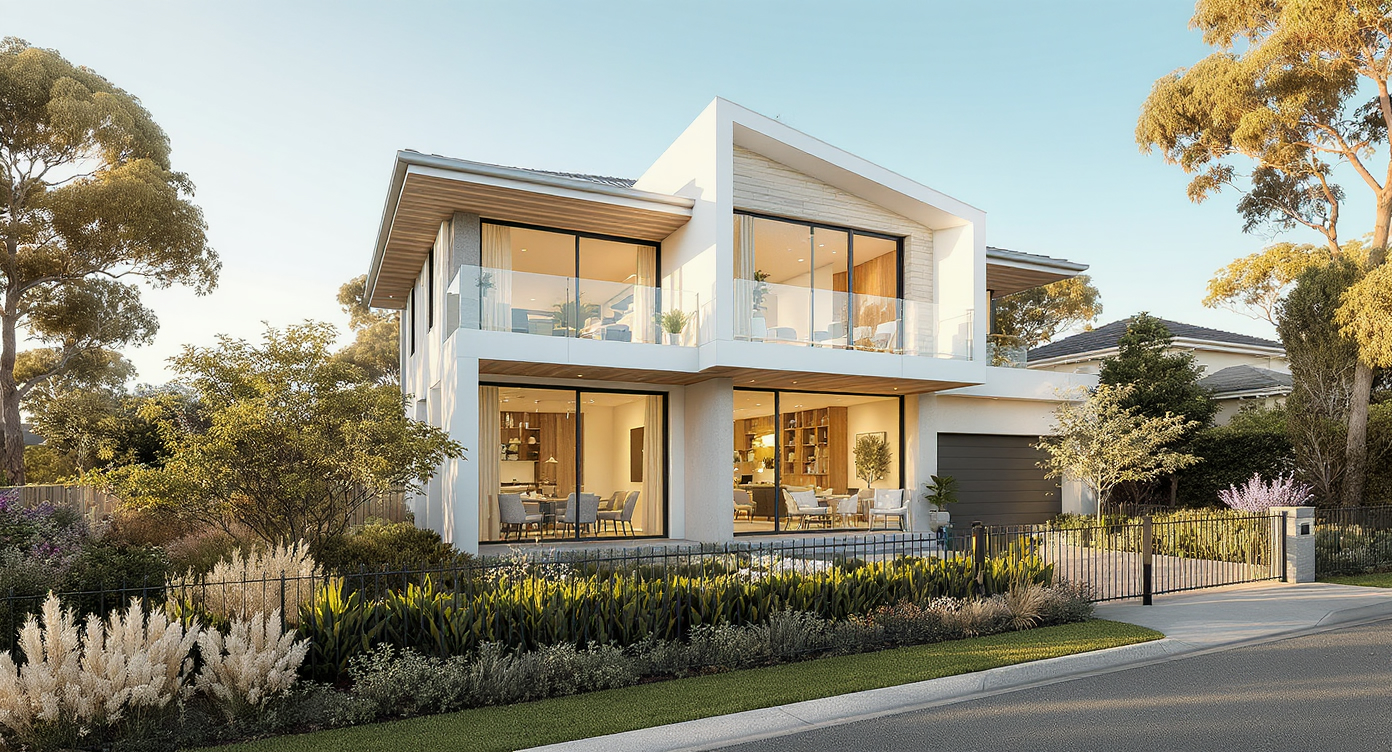
The short answer: An investment property purchase should be assessed on rental yield and cashflow, not suburb appeal or price growth alone. Properties like a $650,000 dual-key generating $42,000 in annual rent (6.5% gross yield) cover holding costs from settlement, unlike a standard $650,000 property yielding 3.4% that can cost $8,000-$12,000 a year out of pocket and reduce borrowing capacity by $100,000 or more.
When you decide to investment property buy, you're making one of the most large financial commitments of your life. Yet most first-time investors approach the purchase with less rigour than they'd apply to buying a car. They chase suburbs they've heard about, properties that "feel right", or deals their mate's cousin recommended. The result? A property that bleeds money every month, constrains their borrowing capacity, and traps them in a portfolio of one.
The difference between wealth-building property investment and expensive mistakes comes down to structure, not luck. Strong rental yields matter more than postcode prestige. Cashflow modelling beats gut instinct. And understanding how one property affects your ability to buy the next is more valuable than any suburb forecast you'll read.
This article breaks down the seven critical factors that separate profitable property purchases from financial anchors. You'll see current market data, specific strategies that generate positive cashflow from settlement day, and the frameworks investors actually use to assess whether a property deserves their capital. Whether you're buying your first investment property or adding to an existing portfolio, these principles determine your outcome.
The Australian property market in 2026 presents a paradox. Property values in capital cities have increased approximately 7% annually over the past decade (CoreLogic), yet many investors who bought during that period are still subsidising their properties from their salary every month. The issue isn't the market, it's the purchase criteria.
Most investors prioritise capital growth over rental yield, assuming price appreciation will eventually justify years of negative cashflow. A property purchased for $650,000 in a premium suburb might generate $22,000 in annual rent, a 3.4% gross yield. After mortgage repayments at current rates, council rates, insurance, property management fees, and maintenance, that property costs the investor $8,000-$12,000 per year out of pocket.
That ongoing cost has two consequences. First, it drains lifestyle, every dollar topping up the property is a dollar not available for living or saving. Second, and more critically, it destroys borrowing capacity. Lenders assess serviceability based on net income after all expenses. A property costing you $10,000 annually reduces what you can borrow for the next purchase. For a household earning $150,000, that single negatively geared property can eliminate $100,000+ in borrowing capacity for subsequent investments.
The alternative approach structures the investment property buy around cashflow first. A dual-key property purchased for the same $650,000 might generate two rental streams totalling $42,000 annually, a 6.5% gross yield. Same purchase price, but the holding costs are covered by rent. The investor's lifestyle remains intact, and their borrowing capacity is preserved or even boosted for property two.
Investors often select locations based on familiarity, media coverage, or aspirational thinking rather than underlying demand fundamentals. A suburb featured in a weekend property supplement receives attention, but attention doesn't equal investment merit. What matters is population growth, infrastructure investment, employment diversity, and lifestyle amenity, factors that drive sustained rental demand and support long-term price stability.
A regional centre with a single dominant employer (mining town, manufacturing hub) might offer attractive entry prices, but the risk profile is high. If that employer downsizes or closes, rental vacancy spikes and property values decline. Conversely, a growth corridor serviced by multiple employment nodes, new transport infrastructure, and expanding residential amenity presents more stable demand. The investment property buy decision should be driven by a checklist of fundamentals, not a feeling about a suburb's potential.
The tension between cashflow and capital growth is the defining strategic question in property investment. Historically, high-growth markets delivered low yields, and high-yield markets delivered modest growth. That trade-off forced investors to choose: build wealth through price appreciation while subsidising holding costs, or generate income with limited capital upside.
Positive cashflow changes the mathematics of portfolio construction entirely. When a property generates more rental income than it costs to hold, it becomes self-sustaining. The investor isn't drawing from their salary to cover the mortgage. Their borrowing capacity isn't eroded by ongoing losses. And they can move toward property two, three, and four without waiting years to recover serviceability.
Consider two investors, each with $100,000 in usable equity and $500,000 in borrowing capacity. Investor A buys a negatively geared property costing $12,000 per year to hold. After two years, they've spent $24,000 from their salary and their net income position has deteriorated, lenders now see reduced capacity. Investor B buys a positively cashflowed property generating $3,000 per year in net income. After two years, they've added $6,000 to their savings, and their income position has improved. Lenders assess them as lower risk with greater capacity.
The compounding effect over a 10-year investment horizon is substantial. Investor A might acquire two properties before hitting their serviceability ceiling. Investor B, with strong cashflow supporting each purchase, might acquire four or five. The difference isn't income or equity, it's strategy. When you investment property buy with cashflow as a primary criterion, you preserve the ability to keep buying.
Dual-key and triple-key investment properties disrupt the traditional growth-versus-yield trade-off. These purpose-built configurations contain two or three self-contained dwellings under a single title, typically a main house plus one or two attached units. Each dwelling has its own entrance, kitchen, bathroom, and living area. Each generates separate rental income.
The structural advantage is mathematical. A standard house in a growth corridor might yield 3.5% gross. A dual-key property in the same corridor, with the same land value and similar construction cost, yields 6-7% gross because you're collecting two rents. The capital growth potential remains intact, the land appreciates, the location benefits from infrastructure investment, but the holding costs are covered from day one.
Triple-key properties extend this further. Three rental streams from one purchase transaction means one stamp duty cost, one loan application, one property management arrangement. For investors with substantial equity positions looking to accelerate income without multiplying complexity, the triple-key structure is one of the highest-yielding residential configurations available. When you investment property buy using these structures, you're not sacrificing growth for yield, you're capturing both.
Property investment carries inherent risk, and pretending otherwise is dangerous. The question isn't whether risk exists, it's whether you've identified it, quantified it, and structured your purchase to manage it. Four risks consistently derail investors who didn't account for them upfront.
Vacancy is the most immediate cashflow risk. If your property sits empty for eight weeks, that's 15% of annual rental income gone. In a market with 5% vacancy rates, extended vacancies become more likely. For an investor relying on rent to cover mortgage repayments, a two-month vacancy can trigger financial stress, especially if they're holding multiple negatively geared properties.
Vacancy risk is mitigated through location selection and property structure. Areas with strong employment diversity, growing populations, and limited rental supply have lower structural vacancy. A dual-key property reduces vacancy risk further, if one tenant leaves, the other is still paying rent. You've lost 50% of income temporarily, not 100%. That buffer matters enormously when cashflow is tight.
Property management quality also affects vacancy duration. A responsive, proactive property manager with strong local networks can turn a property around faster than a reactive one. When you investment property buy, factor property management into your risk assessment, it's not an afterthought, it's a critical component of income reliability.
Interest rate cycles are inevitable. The cash rate in Australia moved from 0.1% in 2021 to 4.35% by late 2023 (Reserve Bank of Australia), and mortgage rates followed. An investor who purchased in 2021 with repayments calculated at 2.5% suddenly faced repayments at 6.5%+. On a $500,000 loan, that's an additional $1,500+ per month in holding costs.
Lenders stress-test borrowing capacity at rates 3% above the actual loan rate precisely because of this risk. But many investors don't stress-test their own cashflow. They calculate affordability at today's rate and assume it will stay there. The properties that survive rate rises are those with strong rental yields that absorb some or all of the increased cost. A property yielding 6.5% has far more buffer than one yielding 3.5%.
Fixed-rate loans provide short-term certainty but eventually revert to variable. The real protection against interest rate risk is purchasing properties that are cashflow-positive or neutral even at elevated rates. When you investment property buy, model the holding costs at 7-8% interest rates, not the current rate. If the numbers still work, the property can weather the cycle.
Serviceability risk is the silent killer of portfolio ambitions. Most investors only discover they're constrained when they apply for their second loan and get declined. The issue isn't equity, they have it. It's that their existing property commitments, combined with their salary and liabilities, leave no capacity for additional borrowing.
Credit card limits are a common culprit. A $30,000 credit card with a zero balance still reduces borrowing capacity by approximately $150,000 because lenders assess the limit, not the balance. Personal loans, car loans, and school fees also reduce capacity. But the largest constraint is negatively geared investment properties. Every dollar they cost per month is deducted from your net income when lenders calculate what you can afford.
Positively cashflowed properties do the opposite, they add to your net income position and support further borrowing. This is why the investment property buy decision must consider not just the property in isolation, but how it affects your ability to execute the next step of your strategy. A portfolio of one is not a portfolio. Structuring each purchase to preserve serviceability is foundational.
Property is an illiquid asset. You can't sell half of it if you need cash. You can't exit in 24 hours. If you're forced to sell during a market downturn, or in a location with limited buyer demand, you might take a loss or wait months for settlement. Liquidity risk is managed through financial buffers and careful location selection.
Maintain an emergency fund covering at least six months of holding costs across your portfolio. That buffer allows you to ride out temporary vacancy, unexpected maintenance, or income disruption without forced sales. Choose locations with strong buyer demand, areas where owner-occupiers and investors both compete. Properties in tightly held suburbs with limited stock sell faster than those in oversupplied or declining markets.
Investment-grade locations aren't identified by gut feel or media hype. They're assessed against a repeatable framework that measures underlying demand fundamentals. The P.I.L.E. framework evaluates four factors: Population, Infrastructure, Lifestyle, and Employment. A location that scores well across all four has genuine, sustained demand that supports both rental income and long-term capital growth.
Population growth drives housing demand. Areas experiencing net migration, whether from overseas, interstate, or intra-city relocation, require additional housing stock. Australia's net overseas migration was approximately 518,000 in 2023 (Australian Bureau of Statistics), with major settlement in growth corridors around Sydney, Melbourne, and Brisbane. Those corridors are where rental and purchase demand is concentrated.
Infrastructure investment signals where governments and private sector expect growth. New transport links (rail extensions, motorway upgrades), hospital expansions, school construction, and commercial precinct development all improve an area's liveability and economic activity. The Western Sydney Aerotropolis, with $20 billion+ in committed infrastructure (NSW Government), is a clear example, the infrastructure precedes the population growth, and property investors who position early benefit from both the construction phase and the long-term demand that follows.
When you investment property buy, check whether the location is experiencing population growth and whether infrastructure investment is planned or underway. If both are absent, the property might look cheap for a reason, there's no underlying demand to support rental growth or price appreciation.
Lifestyle amenity determines whether residents stay or leave. Areas with quality schools, shopping precincts, parks, healthcare facilities, and recreational options attract families and professionals. These residents become long-term tenants and eventual owner-occupier buyers. Lifestyle isn't subjective, it's measurable through facility density, council investment in public amenity, and demographic stability.
Employment diversity is the ultimate retention factor. A location with multiple industries, large employers, and a mix of blue-collar and white-collar jobs can absorb economic shocks. If one sector declines, others provide employment continuity. Regional cities like Geelong (manufacturing, healthcare, education, logistics) and Wollongong (steel, university, tourism, port operations) demonstrate this diversity. Single-industry towns do not.
The P.I.L.E. framework forces disciplined assessment. A property might have strong cashflow, but if the location scores poorly on employment diversity or infrastructure investment, the yield might not be sustainable. When you investment property buy, apply the checklist, don't skip it because the numbers look attractive on paper.
Ready to take the next step with Somerstone Property Group?
Our team is ready to help you achieve your goals. Book a discovery call.
Positive cashflow sounds theoretical until you see the actual numbers. Take a look at a realistic scenario based on a dual-key investment property purchased in a growth corridor approximately 40 kilometres from a capital city CBD in 2026.
Purchase price: $620,000. Loan amount (80% LVR): $496,000. Main dwelling rental income: $480/week ($24,960/year). Attached dwelling rental income: $360/week ($18,720/year). Total gross rental income: $43,680/year (7.0% gross yield).
Annual holding costs: mortgage repayments at 6.5% interest-only ($32,240), council rates ($2,200), insurance ($1,400), property management at 7% ($3,058), maintenance allowance ($2,500), total costs ($41,398). Net cashflow before tax: $2,282 positive. Add depreciation deductions (first-year estimate $16,000), and the tax benefit at 37% marginal rate is approximately $5,920. Effective annual cashflow after tax: $8,202 positive.
That's $683 per month in positive cashflow. The property isn't costing the investor anything, it's paying them. Compare this to a standard house purchased for the same price yielding 3.8% ($23,560 annual rent). After the same holding costs, that property would be approximately $17,838 per year negative before tax. Over five years, the dual-key property generates $41,010 in cumulative positive cashflow while the standard house costs the investor $89,190 in cumulative top-ups. The difference is $130,200 in cashflow position over five years from the same initial capital outlay.
New-build investment properties offer full access to depreciation deductions, both Division 43 (capital works at 2.5% per year over 40 years) and Division 40 (plant and equipment with varying effective lives). For a new dual-key property with a construction value of $400,000, first-year depreciation typically reaches $15,000-$18,000. Over five years, cumulative deductions of $60,000-$70,000 are common.
At a 37% marginal tax rate, $65,000 in depreciation deductions over five years translates to $24,050 in tax savings. That's real money returned to the investor annually, reducing the effective cost of ownership or boosting the net return. Established properties built before 2017 offer limited depreciation, Division 43 only, and only for the remaining years of the 40-year schedule. For properties built in the 1990s, the depreciation is minimal.
When you investment property buy, the age of the property directly affects the tax benefits available. New builds maximise depreciation. Established properties don't. That difference compounds over the hold period and materially affects your net return. A depreciation schedule prepared by a qualified quantity surveyor costs $600-$800 and is itself tax-deductible, it should be commissioned before your first tax return is lodged.
A single investment property is a start. A portfolio is a wealth-building system. The transition from one to multiple properties requires deliberate sequencing, equity management, and serviceability preservation. Most investors stall at property one or two because they didn't structure the first purchase with the second and third in mind.
Equity recycling is the process of accessing accumulated equity in existing properties to fund deposits for subsequent purchases. As property values increase and loans are paid down, usable equity grows. Lenders typically allow access to 80% of a property's value minus the existing loan balance. A property purchased for $600,000 that appreciates to $720,000 over five years, with the loan reduced to $450,000, has approximately $126,000 in usable equity ($720,000 × 80% = $576,000, minus $450,000 loan = $126,000).
That $126,000 can fund the deposit and acquisition costs for property two without touching cash savings. If property two is also structured for positive cashflow, the portfolio now generates two income streams while maintaining or improving overall serviceability. As property two appreciates, its equity becomes available for property three. The cycle repeats, constrained only by serviceability and risk tolerance.
Somerstone Property Group's approach to investment property buy decisions centres on this sequencing. Rather than operating from a fixed list of available properties, they model each client's equity position, borrowing capacity, and 10-year acquisition roadmap before recommending specific assets. The strategy comes first, the property is found to fit it. This structure allows clients to build portfolios of three, four, or five properties over a decade, with each purchase preserving the capacity for the next.
The compounding effect of positive cashflow across a portfolio is substantial. One property generating $3,000 per year in net income is useful. Three properties generating $9,000 per year collectively is transformational, that's $750 per month in passive income before accounting for capital growth. Five properties generating $15,000 per year collectively is $1,250 per month, enough to cover many households' living expenses.
But the real power isn't just the income, it's the serviceability support. Each positively cashflowed property improves the investor's net income position in the eyes of lenders, making the next purchase easier to approve. Negatively geared properties do the opposite, they reduce net income and constrain further borrowing. A portfolio of three positively cashflowed properties might support borrowing capacity for properties four and five. A portfolio of three negatively geared properties might prevent any further acquisition.
When you investment property buy with portfolio construction in mind, you're not optimising for the individual asset, you're optimising for how that asset interacts with the next three. That's the difference between owning property and building wealth through property.
Rentvesting, renting where you want to live while owning investment property elsewhere, is increasingly the smarter financial path for professionals aged 25-40 in expensive capital cities. The traditional approach of buying a home first, then maybe investing later, consumes borrowing capacity on a lifestyle asset with limited financial return. Rentvesting inverts that: allocate borrowing capacity to income-producing investment property, and rent affordably in the location that suits your lifestyle.
A professional couple earning $180,000 combined with $120,000 in savings and $650,000 in borrowing capacity face a choice. Path A: buy a $750,000 townhouse in an inner suburb as their home. They'll pay $3,200/month in mortgage repayments, receive no rental income, and consume 100% of their borrowing capacity. They own one property, their home, and have no capacity for investment property.
Path B: rent a similar townhouse for $2,600/month and use their borrowing capacity to purchase a $600,000 dual-key investment property. The investment generates $3,400/month in combined rent, costs $2,800/month to hold (mortgage, rates, insurance, management), and produces positive cashflow of $600/month. After five years, they've built equity in an income-producing asset, retained $150,000+ in residual borrowing capacity, and are positioned to purchase property two. When they eventually buy a home, they'll do so from a position of strength, with an established investment portfolio generating income.
The trade-off is the loss of the main residence capital gains tax exemption on the investment property, and the psychological satisfaction of ownership. But for wealth-focused investors, the mathematics favour investing first. Rentvesting allows you to investment property buy without sacrificing lifestyle or locking all your capital into a non-income-producing asset.
Over a 10-year horizon, the wealth gap between rentvesting and traditional home ownership can be substantial. The homeowner who bought a $750,000 property in year one and held it owns one asset worth approximately $1.05 million (assuming 3.5% annual growth), with a loan of $550,000 (assuming some principal reduction). Net equity: $500,000.
The rentvester who invested $600,000 in year one in a positively cashflowed property, then used accumulated equity and preserved borrowing capacity to purchase properties two and three in years four and seven, owns three properties with a combined value of approximately $1.95 million (assuming similar growth rates) and combined loans of $1.35 million. Net equity: $600,000. Plus they've collected cumulative positive cashflow of $50,000+ across the portfolio over the decade.
The rentvester has built a larger equity position, generated passive income, and created a self-sustaining wealth system. The homeowner has security and a tangible lifestyle asset, but less wealth and no income stream. Neither path is universally right, the decision depends on your priorities, risk tolerance, and financial goals. But for investors serious about building long-term wealth through property, rentvesting deserves serious consideration.
The investment property buy decision is not about finding the cheapest property or the suburb with the best forecast. It's about structuring the purchase to serve your 10-year wealth strategy. Properties that generate positive cashflow from settlement preserve your borrowing capacity and allow you to keep buying. Properties that cost you money every month trap you in a portfolio of one.
Location matters, but not for the reasons most investors think. What matters is population growth, infrastructure investment, employment diversity, and lifestyle amenity, the P.I.L.E. framework that measures genuine underlying demand. Dual-key and triple-key structures disrupt the traditional trade-off between cashflow and growth, delivering both from a single purchase.
If you're serious about building wealth through property, start with strategy. Model your equity position, borrowing capacity, and cashflow requirements before you look at a single property listing. The plan comes first, always. When you investment property buy with that discipline, you're not gambling on a suburb's potential. You're executing a repeatable system that compounds over time.
Most lenders require a 20% deposit plus acquisition costs (stamp duty, legal fees, building inspections) to avoid lenders mortgage insurance. For a $600,000 property, that's $120,000 deposit plus approximately $30,000-$35,000 in costs. Some lenders accept 10% deposits with LMI, but the additional insurance cost reduces your return and borrowing capacity.
Calculate total annual rental income, then subtract all holding costs: mortgage repayments (use current interest rates plus 1-2% buffer), council rates, insurance, property management fees (typically 7-8% of rent), and a maintenance allowance (1-2% of property value annually). If rental income exceeds costs, it's positive. Include depreciation deductions to calculate after-tax cashflow.
You can, but the complexity increases considerably with each property. Managing equity calculations, lender sequencing, cashflow modelling, and location assessment across multiple purchases requires substantial time and expertise. Most successful portfolio builders either develop this capability over years or work with specialists who manage the process. The cost of a strategic error (wrong property, wrong location, wrong loan structure) typically exceeds the cost of professional guidance.
Strategy means each property is selected based on how it serves your overall wealth plan, cashflow targets, equity accumulation, tax positioning, and portfolio diversification. Buying any rental property is opportunistic and often emotion-driven. Strategic investors model serviceability impact, assess risk across the portfolio, and structure each purchase to enable the next. One-off buyers often get stuck at property one because they didn't plan for property two.
The answer depends on your income, equity position, and portfolio stage. High-income earners with strong borrowing capacity can absorb negative gearing in exchange for growth. Lower-income or serviceability-constrained investors need positive cashflow to preserve borrowing capacity. The ideal approach captures both, dual-key and triple-key properties in growth corridors deliver strong yields (6-7%+) while maintaining capital growth potential. Don't accept the false choice between cashflow and growth when structures exist that provide both.
