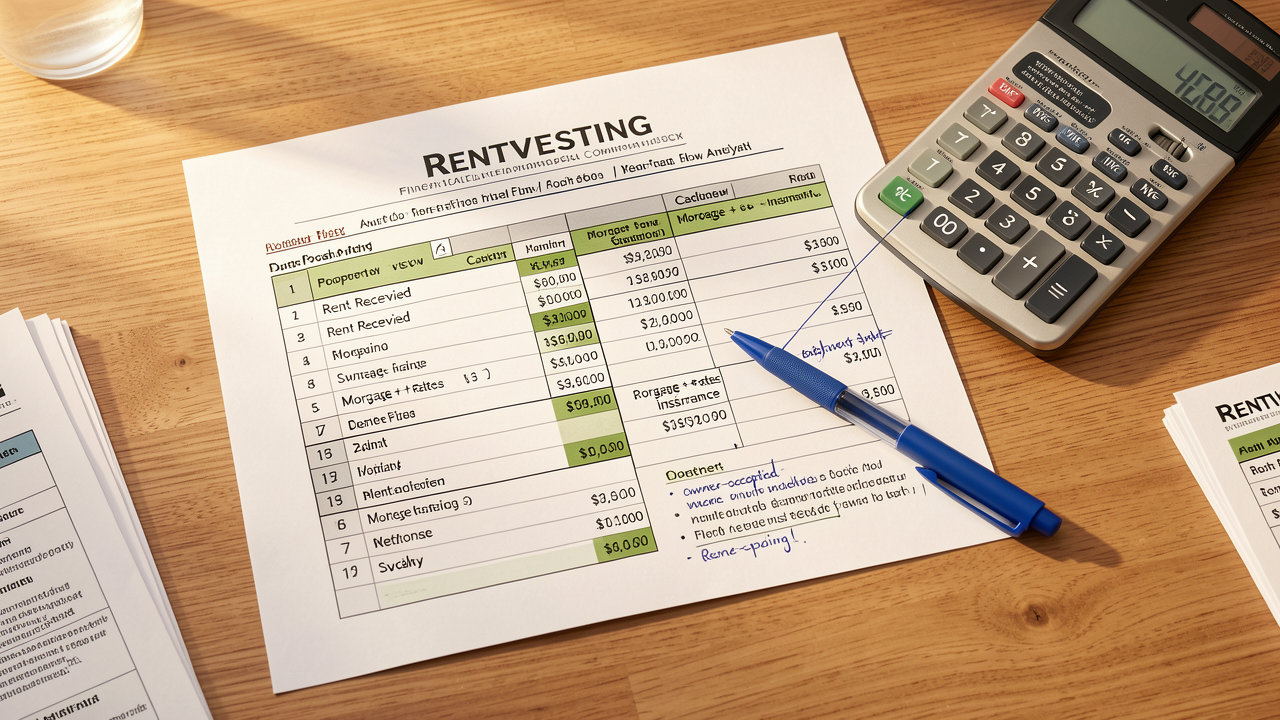
The short answer: Rentvesting, renting where you want to live while owning investment property elsewhere, offers lifestyle flexibility and earlier market entry, but adds landlord obligations, vacancy risk, and potential loss of first-home-buyer benefits. The strategy works best when rental income covers most ownership costs and your timeline is 7+ years.
Rentvesting pros and cons dominate Australian property forums for good reason. The strategy lets you live in a premium suburb while building wealth through investment property in a more affordable market. But it's not a free lunch, you're paying rent and a mortgage simultaneously, managing tenants remotely, and potentially forfeiting state-based first-home concessions worth thousands.
The decision hinges on cash flow, not aspiration. Can the investment property's rental income cover its mortgage, rates, insurance, and management fees? Will your own rent remain affordable as inner-city prices climb? And critically, does the long-term capital growth justify the complexity and cost of running two properties at once?
This article breaks down the financial mechanics, tax implications, and lifestyle trade-offs. You'll see worked examples comparing rentvesting with buying an owner-occupied home, understand how first-home-buyer rules vary by state, and learn when the strategy accelerates wealth, and when it only doubles your housing stress.
Rentvesting means renting your principal residence while owning an investment property tenanted by someone else. You live in the suburb that suits your work, family, or lifestyle, often an expensive inner-city area, while your investment property sits in a regional town, outer suburb, or interstate market where purchase prices and rental yields are more favourable.
The strategy emerged as Australian capital-city property prices outpaced wage growth. According to CoreLogic data, Sydney's median house price reached $1.4 million by late 2024, while Melbourne sat at $1.1 million. For a professional couple earning $180,000 combined, buying a home in these markets consumes most borrowing capacity and leaves little room for further investment. Rentvesting flips the equation: rent affordably, invest where the numbers work.
Rentvesting lets you live near your workplace, avoid two-hour commutes, and access the amenities that matter, cafes, schools, parks, culture, without the $1.2 million mortgage. Your rental cost might be $2,800 per month for a two-bedroom apartment in Fitzroy or Newtown. Meanwhile, your $550,000 investment property in regional Victoria or Queensland generates $2,600 per month in rent and costs $2,400 in mortgage repayments.
The Australian Bureau of Statistics reported that 31% of renters in 2023 cited proximity to work as their primary location driver, compared with 18% of owner-occupiers. Rentvesting preserves that flexibility. If your job changes, your partner relocates, or your family needs shift, you can move without selling a property or refinancing a home loan.
Rentvesting also accelerates market entry. A first-home buyer targeting a $900,000 property needs a $180,000 deposit plus $40,000 in stamp duty and costs, $220,000 total. That same capital buys a $600,000 investment property with $120,000 down, leaving $100,000 for a second deposit or emergency buffer. Data from the Reserve Bank of Australia shows the average age of first-home buyers reached 36 in 2024, up from 32 a decade earlier. Rentvesting lets younger professionals enter the market sooner and begin building equity while prices continue rising.
For investors focused on portfolio construction, rentvesting preserves borrowing capacity. An owner-occupied mortgage on a $900,000 property at 6.5% costs $5,700 per month with no rental offset. An investment loan on a $600,000 property costs $3,800 per month but generates $2,600 in rent, netting to $1,200. The bank's serviceability assessment sees the investment property as less of a drain, leaving room for property two and three. Craig's words: "Where you live and where you invest don't have to be the same decision."
The rentvesting pros and cons become tangible when you model the cash flow. Most online discussions stop at "you pay rent and a mortgage", but the real question is whether the investment property's income covers enough of its costs to make the combined position sustainable.
Consider a typical scenario: you rent a two-bedroom apartment in an inner suburb for $2,400 per month. You own a $550,000 dual-key investment property in a growth corridor, financed with a $440,000 loan at 6.5% interest-only. The property generates $2,800 per month in combined rent from two tenancies. Monthly costs break down as: $2,387 mortgage interest, $180 council rates, $80 insurance, $200 property management (7% of rent), $150 maintenance allowance, $120 strata fees. Total: $3,117 per month.
Rental income of $2,800 leaves a $317 monthly shortfall before tax. But the property also generates $18,000 in first-year depreciation deductions. On a 37% marginal tax rate, that's a $6,660 annual tax refund, $555 per month. Net position: $238 per month positive cash flow after tax, while renting your own home for $2,400. Combined housing cost: $2,162 per month. The numbers above assume full occupancy, but a rentvesting calculator lets you model vacancy scenarios and stress-test your cash flow before committing.
Now compare that with buying a $750,000 home to live in. With a $600,000 mortgage at 6.5%, repayments are $3,794 per month (principal and interest). Add $200 rates, $100 insurance, $150 maintenance. Total: $4,244 per month. No rental income. No depreciation. No tax deductions on the mortgage interest because it's your home, not an investment.
The rentvestor's combined position costs $2,162 per month and builds equity in an income-producing asset. The homeowner pays $4,244 per month and builds equity in their residence. Over five years, the rentvestor has spent $129,720 on housing while accumulating rental income and tax benefits. The homeowner has spent $254,640. The $124,920 difference funds lifestyle, savings, or a second investment deposit.
| Factor | Rentvesting | Owner-Occupied Home |
|---|---|---|
| Monthly housing cost | $2,162 (rent + net property cost) | $4,244 (mortgage + ownership costs) |
| Tax deductions | Interest, depreciation, all expenses | None |
| Rental income | $2,800/month from investment | None |
| Capital gains tax | Payable on investment sale | Exempt on main residence |
| Borrowing capacity impact | Rental income offsets loan | Full mortgage counted |
The numbers above assume full occupancy. If the investment property sits vacant for six weeks per year, you lose $3,230 in rent and still pay all ownership costs. That six-week gap turns a $238 monthly surplus into a $31 monthly loss, manageable, but it highlights the importance of tenant demand and property management quality.
Research from SQM Research shows national vacancy rates averaged 1.8% in 2024, but regional markets varied from 0.6% to 4.2%. A property in a high-vacancy market requires a larger cash buffer. The rentvesting pros and cons shift substantially when vacancy risk is high or rental growth is weak. If your investment property's rent doesn't keep pace with your own rising rent, the strategy's affordability advantage erodes over time.
Rentvesting pros and cons extend well beyond monthly cash flow. The tax treatment and eligibility for government concessions can add or subtract tens of thousands of dollars from the long-term outcome.
When you own an investment property, every dollar of mortgage interest, council rates, insurance, property management fees, repairs, and depreciation is tax-deductible. On a $440,000 loan at 6.5%, annual interest is $28,600. Add $2,160 rates, $960 insurance, $2,400 management, $1,800 maintenance, $1,440 strata, and $18,000 depreciation. Total deductions: $55,360. At a 37% marginal rate, that's a $20,483 tax refund, $1,707 per month.
This is negative gearing: the property's costs exceed its income, and the loss offsets your salary to reduce tax. The Australian Taxation Office reported that 2.2 million Australians claimed rental property deductions in 2022-23, with an average deduction of $13,900. The tax benefit is real, but it's not free money, you're still out of pocket before the refund arrives, and the refund only recovers a portion of the loss.
The major tax trade-off is capital gains tax (CGT). When you sell your main residence, any capital gain is tax-free under the main residence exemption. When you sell an investment property, you pay CGT on the profit. If you bought for $550,000 and sold for $750,000 after seven years, the $200,000 gain is added to your taxable income. With the 50% CGT discount for assets held over 12 months, $100,000 is taxable. At 37%, that's a $37,000 tax bill.
For a homeowner, that same $200,000 gain is tax-free. Over a 20-year hold, the CGT difference can exceed $100,000. This is the single largest financial cost of rentvesting and the reason the strategy works best when the investment property's superior yield and growth more than compensate for the tax hit.
Most Australian states offer first-home-buyer stamp duty concessions or exemptions, but only for owner-occupied purchases. In Victoria, first-home buyers pay no stamp duty on properties up to $600,000 and reduced duty up to $750,000, a saving of up to $30,000. In New South Wales, the First Home Buyer Assistance scheme exempts duty on properties up to $800,000.
If you buy an investment property first, you are no longer a first-home buyer in most states. When you eventually purchase a home to live in, you pay full stamp duty. According to Revenue NSW, this can cost $25,000-$40,000 on a typical Sydney property. Some states allow the concession if you have only ever owned investment property and are now buying your first home, but the rules vary. Queensland, for example, requires that you have never owned property anywhere in Australia. Some states allow the concession if you have only ever owned investment property and are now buying your first home, but the rules vary, and understanding rentvesting in Australia requires navigating each jurisdiction's specific legislation.
The decision to rentvest often means permanently forfeiting these concessions. For a professional planning to buy a home within five years, that's a major cost. For someone committed to building a portfolio and potentially never buying an owner-occupied property, it's irrelevant. The rentvesting pros and cons must be weighed against your long-term housing intentions, not just today's cash flow.
The financial case for rentvesting can look compelling on a spreadsheet, but the lived experience involves trade-offs that don't show up in a cash-flow model. You're simultaneously a tenant and a landlord, subject to someone else's rules while enforcing your own on a property you don't occupy.
As a renter, you have limited control. Your landlord can increase rent, sell the property, or refuse permission for modifications. The Tenants' Union of NSW reported that 38% of renters in 2023 experienced an unwanted rent increase, and 12% were forced to move due to lease non-renewal or sale. That instability is the cost of flexibility. You can't renovate, can't get a dog without approval, and can't assume you'll stay beyond the lease term.
Meanwhile, you're managing an investment property, possibly interstate. Tenant selection, maintenance requests, lease renewals, rent arrears, and property inspections all require attention. A quality property manager handles day-to-day operations, but you still make the decisions: approve repairs, set rent, choose tenants from a shortlist. If the hot water system fails on a Saturday night, you're paying for the callout even if you're 800 kilometres away.
Australians have a deep cultural attachment to homeownership. The Australian Housing and Urban Research Institute found that 72% of Australians consider owning a home "highly important" to their sense of security and identity. Rentvesting requires letting go of that narrative, at least temporarily.
For some, renting indefinitely feels like failure, even when the investment portfolio is growing. For others, it's liberating. The difference often comes down to personality and priorities. If you value autonomy, stability, and the ability to renovate your kitchen without asking permission, rentvesting will feel like a compromise. If you value location, flexibility, and wealth accumulation over emotional ownership, it's a strategic trade-off.
There's also the risk that your own rent rises faster than expected. Inner-city rental markets in Sydney and Melbourne saw annual increases of 8-12% in 2023-24, according to CoreLogic. If your rent climbs from $2,400 to $2,900 per month while your investment property's rent grows only 3% annually, the affordability advantage narrows. After five years of compounding rent increases, the rentvestor's combined housing cost may approach or exceed the homeowner's fixed mortgage repayment.
Managing an investment property from a distance introduces friction. You can't inspect the property yourself. You rely on your property manager's reports, photos, and judgment. If a tenant reports a leaking tap, you can't drop by to assess whether it's urgent or cosmetic. You're making financial decisions, approve a $1,200 plumber callout or wait until Monday, based on secondhand information.
Quality property management is non-negotiable for rentvestors. A poor manager lets maintenance slide, selects unreliable tenants, and fails to enforce lease terms. The result is higher vacancy, lower rent, and unexpected repair bills. Management fees typically run 7-9% of rent plus letting fees, but the difference between a competent manager and a mediocre one can cost thousands annually in lost income and avoidable repairs.
Ready to take the next step with Somerstone Property Group?
Our team is ready to help you achieve your goals. Book a discovery call.
Rentvesting pros and cons aren't universal, they depend on your income, equity position, timeline, and priorities. The strategy works best in specific circumstances and fails in others.
Rentvesting makes sense when you're a high-income professional with strong serviceability but limited savings. If you earn $150,000+ but have only $80,000 in deposit funds, buying a $700,000 home in your preferred suburb is out of reach. Buying a $500,000 investment property with strong yield preserves your lifestyle, gets you into the market, and builds equity for future purchases. Within three years, capital growth and loan paydown may give you the deposit for an owner-occupied home, or a second investment property.
It also works when your location needs are temporary. If you're in a city for a three-year work contract, buying a home to live in for such a short period incurs high transaction costs, stamp duty, conveyancing, selling agent fees, that erode any capital gain. Renting locally and owning an investment property elsewhere lets you build wealth without the friction of buying and selling within a short window. The rentvestor's combined position costs $2,162 per month and builds equity in an income-producing asset, and the full comparison of rentvesting vs buying shows how each path performs over different time horizons.
Rentvesting fails when the investment property's cash flow is deeply negative and your income can't absorb the shortfall. If the property costs $4,200 per month and generates $2,400 in rent, you're topping up $1,800 monthly before tax. Add your own $2,600 rent, and your combined housing cost is $4,400 per month, higher than just buying a home. The tax refund helps, but it arrives annually, not weekly, and doesn't cover the full loss.
It also fails when you're certain you want to buy a home within two years and your state offers meaningful first-home-buyer concessions. Forfeiting a $30,000 stamp duty exemption to rentvest for 18 months makes little sense unless the investment property's growth and income dramatically outperform a home purchase, and over such a short period, that's unlikely.
The strategy is weakest for investors who lack the discipline or systems to manage a property remotely. If you ignore maintenance requests, delay repairs, or choose the cheapest property manager, tenant turnover and vacancy will erode returns. Rentvesting requires treating the investment property as a business asset, not a passive holding. If that feels like a burden rather than a wealth-building tool, buying a home and investing later may be the better path.
Property investment works on long timeframes. Transaction costs, stamp duty, conveyancing, building inspections, selling agent fees, typically total 7-10% of the purchase price. To recover those costs and benefit from capital growth, you need to hold the property for at least seven years. Rentvesting is not a two-year experiment. It's a medium-term strategy that assumes you're comfortable renting for the foreseeable future and committed to holding the investment property through at least one full property cycle.
If your timeline is shorter, the rentvesting pros and cons tilt toward just saving a larger deposit and buying a home when you're ready. The flexibility and tax benefits don't compensate for the transaction costs and CGT liability on a short hold.
For investors building a multi-property portfolio, rentvesting can be the foundation. The first investment property generates equity and rental income. That equity funds the deposit for property two. The combined rental income from both properties supports further borrowing. Within a decade, a disciplined rentvestor can own three or four income-producing properties while still renting in their preferred location, a wealth position far ahead of a single homeowner with a large mortgage. Book a strategy call to model your specific scenario and see whether rentvesting accelerates or delays your wealth timeline.
The rentvesting pros and cons are not abstract, they're specific to your income, deposit, borrowing capacity, tax rate, location preferences, and timeline. A generic "pros and cons" list won't tell you whether the strategy works for you. You need a scenario model that compares the two paths with your actual numbers.
Start with your current financial position. What's your household income? How much deposit and equity do you have? What's your borrowing capacity? A mortgage broker can provide a serviceability assessment showing the maximum loan amount banks will approve. That figure determines what you can buy, whether as an owner-occupier or investor.
Next, model the owner-occupied path. Find a property in your target suburb at the upper limit of your borrowing capacity. Calculate the monthly mortgage repayment (principal and interest), rates, insurance, and maintenance. That's your total monthly housing cost. No rental income. No tax deductions. But also no landlord risk, no CGT on sale, and eligibility for first-home-buyer concessions if applicable.
Now model the rentvesting path. Find a rental property in your preferred suburb and note the monthly rent. Then identify an investment property, ideally a high-yield, positive-cashflow asset like a dual-key or triple-key property, within your borrowing capacity. Calculate its monthly costs: mortgage interest (use interest-only for the first five years to maximise cash flow), rates, insurance, strata, property management, and a maintenance allowance. Subtract the expected rental income.
Add the first-year depreciation deductions and multiply by your marginal tax rate to estimate the annual tax refund. Divide by 12 to get the monthly tax benefit. Combine your rental cost and the investment property's net cost after tax. That's your total monthly housing cost as a rentvestor. For investors focused on portfolio construction, rentvesting preserves borrowing capacity, and the benefits of rentvesting extend beyond cash flow to include lifestyle flexibility and accelerated market entry.
Compare the two figures. If rentvesting costs $2,200 per month and buying a home costs $4,100, the annual saving is $22,800. Over five years, that's $114,000, enough for a second investment deposit or a future home deposit. But also factor in the CGT liability when you eventually sell the investment property, and the lost first-home-buyer concessions if you later buy a home.
Run the model under different assumptions. What if your rent increases 8% annually? What if the investment property sits vacant for two months in year three? What if interest rates rise 1.5%? What if the property's value grows 4% annually instead of 6%? Stress-testing reveals whether the strategy is solid or fragile.
The Australian Prudential Regulation Authority requires banks to assess loan serviceability at an interest rate 3% above the actual rate. Apply the same discipline to your own model. If a 3% rate rise makes the investment property unaffordable, the strategy is too applied. If you can still service both the investment loan and your rent at higher rates, the position is sustainable.
Finally, consider the non-financial factors. How important is homeownership to your sense of security? How comfortable are you managing a property remotely? How stable is your income? How likely are you to relocate in the next five years? The rentvesting pros and cons include lifestyle and emotional dimensions that a spreadsheet can't capture. The right decision balances the numbers with your priorities and risk tolerance.
Rentvesting pros and cons come down to cash flow, tax treatment, and timeline. The strategy works when the investment property's rental income covers most ownership costs, your own rent remains affordable, and you're committed to holding the asset for seven-plus years. It fails when the combined housing cost exceeds buying a home, when you forfeit valuable first-home-buyer concessions for a short-term hold, or when remote landlord obligations become a burden rather than a wealth-building tool.
The financial advantage is real for high-income professionals who want to live in expensive suburbs while building investment portfolios. The tax deductions, rental income, and preserved borrowing capacity can accelerate wealth accumulation compared with buying a single owner-occupied home. But the strategy requires discipline, quality property management, and a clear-eyed assessment of vacancy risk, CGT liability, and your own rent trajectory.
Model your specific scenario before committing. Compare the monthly costs, stress-test the assumptions, and factor in the non-financial trade-offs. Rentvesting isn't right for everyone, but for the right investor with the right property and the right timeline, it's a legitimate path to building wealth while maintaining lifestyle flexibility.
Pros include lifestyle flexibility, earlier market entry, rental income, tax deductions, and preserved borrowing capacity. Cons include paying rent and a mortgage simultaneously, landlord obligations, vacancy risk, capital gains tax on sale, and potential loss of first-home-buyer concessions.
In most states, buying an investment property first disqualifies you from first-home-buyer stamp duty concessions when you later purchase a home. Rules vary by state, Queensland requires you've never owned property anywhere, while some states allow concessions if your first purchase was investment-only.
Add your monthly rent to the investment property's net cost after rental income and tax refunds. Compare that total to the monthly cost of buying a home (mortgage, rates, insurance, maintenance). Include a buffer for vacancy and rent increases. Stress-test at higher interest rates.
Banks count 80% of the investment property's rental income as assessable income, which offsets the loan repayments in their serviceability calculation. A positive-cashflow property improves borrowing capacity; a negatively geared property reduces it. Your own rent is counted as a living expense, slightly reducing capacity.
Probably not. Transaction costs and CGT liability make rentvesting inefficient over short timeframes. You'll also forfeit first-home-buyer concessions. If your timeline is under five years and you're certain you want to buy a home, saving a larger deposit and buying when ready is typically the better path.
