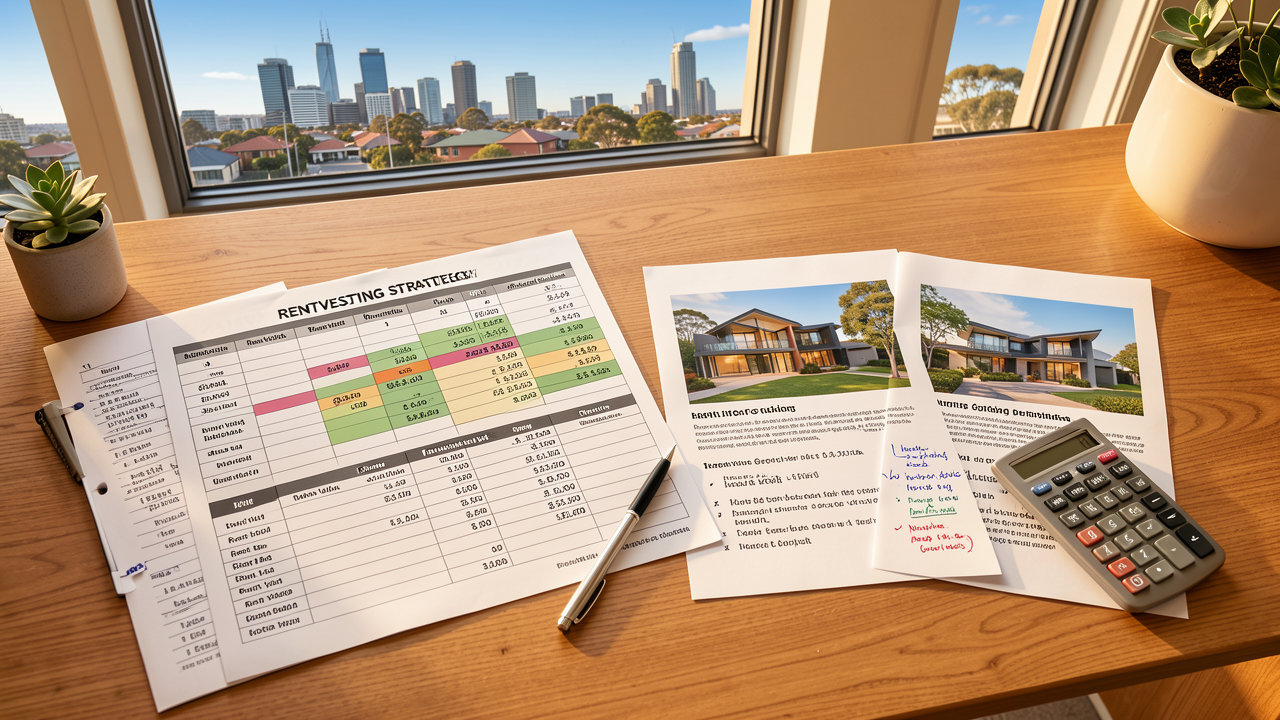
The short answer: Rentvesting Australia Reddit discussions reveal a strategy where you rent where you want to live while owning investment property elsewhere. It offers lifestyle flexibility and earlier property ownership, but you'll forfeit main residence CGT exemption and may lose first-home buyer grants. Success depends on your income, target location, borrowing capacity, and whether strong rental yields offset the tax trade-offs.
Scroll through any Australian property subreddit and you'll find hundreds of threads debating the same question: should I stretch to buy where I want to live, or rent there and invest somewhere the numbers actually work?
Rentvesting Australia Reddit conversations capture something most polished property guides miss, the genuine confusion, trade-offs, and emotional tension young professionals face when housing affordability forces a choice between lifestyle and investment strategy. These threads expose real concerns: losing first-home buyer grants, navigating negative gearing, managing tenants while being a tenant yourself, and whether the tax disadvantages outweigh the financial flexibility.
The problem? Reddit delivers authentic experience but rarely provides current tax rules, state-by-state eligibility checks, or structured cashflow modelling. This article combines the lived insights from rentvesting Australia Reddit discussions with authoritative data, regulatory context, and a clear decision framework. You'll understand what rentvesting actually means in 2026, how first-home concessions interact with investment purchases, the real tax implications, and a step-by-step approach to determining whether this strategy suits your situation.
The most active rentvesting Australia Reddit threads centre on four recurring questions: whether rentvesting delays buying a future home, how first-home grants are affected, whether negative gearing justifies the complexity, and how to choose between lifestyle flexibility and housing security.
Reddit discussions often blur the lines between buying to live in, renting indefinitely, rentvesting, and pure investment. A typical rentvesting Australia Reddit post reads: "I can afford a unit in the outer suburbs or rent in the inner city and buy an investment property, which builds wealth faster?"
The confusion is understandable. Buying to live in means all borrowing capacity goes toward one owner-occupied property with no rental income. Renting indefinitely preserves flexibility but builds no property equity. Rentvesting splits the equation, you rent your lifestyle location while owning an income-producing asset elsewhere. Pure investment means buying property solely for returns while continuing to rent or live with family.
According to CoreLogic's 2025 Housing Affordability Report, Sydney's median house price reached $1.4 million while Melbourne hit $980,000. For a professional earning $120,000 annually, the deposit and serviceability hurdle for an owner-occupied inner-city property can consume 100% of borrowing capacity. Rentvesting redirects that same capacity toward a $550,000 dual-key property in a regional growth corridor yielding 6.5%, generating rental income that supports further borrowing rather than draining it.
Rentvesting Australia Reddit threads deliver valuable peer experience but lack systematic decision tools. You'll find personal anecdotes about vacancy rates, tenant damage, and rent increases, all legitimate concerns, but rarely a worked cashflow comparison showing after-tax cost of ownership versus renting.
The Australian Taxation Office's 2024 data shows 2.3 million Australians own investment property, yet most Reddit contributors don't distinguish between negative gearing (a tax loss) and positive cashflow (actual income after all expenses). A comment claiming "negative gearing saved me $8,000 in tax" often omits that the property cost $20,000 more to hold than it earned, the tax benefit partially offset a real loss.
What's missing is a framework that accounts for: rental income, mortgage interest, property management fees (typically 6-8% of rent plus GST), council rates, insurance, maintenance (budget 1% of property value annually), land tax thresholds, depreciation schedules, and capital gains tax on eventual sale. Without this structure, rentvesting Australia Reddit debates become opinion exchanges rather than informed decisions.
The single most consequential question in rentvesting Australia Reddit discussions is whether buying an investment property first disqualifies you from future first-home buyer benefits. The answer varies greatly by state and has changed substantially in recent years.
First Home Owner Grant (FHOG) and stamp duty concessions are state-administered, and the eligibility rules differ materially. In Victoria, the FHOG provides $10,000 for new builds valued up to $750,000 (as of July 2024), but you must be purchasing your first home and intend to occupy it as your principal place of residence for at least 12 continuous months. Buying an investment property first permanently disqualifies you.
New South Wales offers no FHOG for established properties but provides stamp duty exemptions for first-home buyers purchasing properties up to $800,000 (full exemption) or $800,000-$1 million (concessional rate). The critical requirement: you cannot have previously owned property in Australia. A rentvesting strategy that involves purchasing investment property first forfeits these concessions.
Queensland's FHOG is $15,000 for new homes valued up to $750,000, again requiring the property to be your principal place of residence. Western Australia, South Australia, Tasmania, Northern Territory and the ACT each operate their own schemes with distinct price caps, property-type restrictions, and occupancy requirements.
Revenue NSW's 2025 data indicates first-home buyer stamp duty concessions saved eligible purchasers an average of $22,000-$31,000 on properties in the $650,000-$800,000 range. For a rentvester, that's $22,000-$31,000 in immediate cost that cannot be recovered, a major trade-off that must be weighed against the investment property's income and growth potential.
This is where rentvesting Australia Reddit discussions often underestimate consequences. Buying an investment property first is an irreversible sequencing decision. You cannot "save" your first-home status for later, once you've owned property, you're classified as a subsequent purchaser.
The question becomes: does the financial advantage of entering the investment market earlier outweigh the lost grants and concessions? For a professional planning to rent in Sydney's inner suburbs for the next five years while building equity through investment property, the answer may be yes. For someone intending to buy an owner-occupied home within 18 months, forfeiting a $25,000 concession to purchase a six-month-earlier investment property rarely makes sense.
A worked example: purchasing a $550,000 dual-key investment property in regional Victoria generates approximately $35,750 annual rent (6.5% gross yield). After mortgage interest ($27,500 at 5% on a $440,000 loan), property management ($2,575), rates and insurance ($2,800), and maintenance ($5,500), the property delivers roughly $2,625 annual cashflow before depreciation. Over three years, that's $7,875 in cumulative cashflow plus any capital growth. Compare that to a $25,000 stamp duty saving on a future owner-occupied purchase, the numbers must be modelled specifically to your situation and timeline.
Negative gearing dominates rentvesting Australia Reddit threads, yet most discussions conflate tax deductions with actual profit. Understanding the mechanics is essential before committing to a rentvesting approach.
Negative gearing occurs when the total costs of owning an investment property exceed the rental income it generates, creating a loss that can be offset against your other income to reduce taxable income. If your investment property costs $32,000 annually to hold (mortgage interest, rates, insurance, management, maintenance, depreciation) but generates only $28,000 in rent, you have a $4,000 loss. On a 37% marginal tax rate, that loss reduces your tax by $1,480, you receive a refund, but you're still $2,520 out of pocket annually.
The Australian Taxation Office's 2023-24 taxation statistics show that 1.3 million Australians claimed rental property deductions totalling $47.8 billion, with an average deduction of approximately $36,800 per investor. However, the median rental income was only $19,200, indicating the majority of Australian investment properties are negatively geared.
Consider the critical insight missing from most rentvesting Australia Reddit discussions: negative gearing is not a wealth-building strategy on its own, it's a tax structure that reduces the cost of holding an asset you expect to appreciate. The wealth comes from capital growth, not the tax deduction. If the property doesn't grow in value, you've just subsidised a tenant's accommodation while receiving a partial tax rebate.
The alternative approach, and the one Somerstone's dual-key and triple-key strategies are built around, is positive cashflow from day one. A property generating $35,750 annual rent with $32,000 in total holding costs (including depreciation) delivers $3,750 annual positive cashflow. You're not relying on future capital growth to justify current losses, the property pays for itself while you benefit from any appreciation.
From a rentvesting perspective, this distinction matters enormously. A negatively geared investment property reduces your borrowing capacity for future purchases because lenders assess the net loss as an ongoing expense. A positively cashflowed property adds to your serviceability, enabling you to acquire additional properties faster. If your rentvesting goal is to build a multi-property portfolio while renting in your preferred location, cashflow structure determines how quickly you can execute that plan. Without a structured rentvesting calculator that accounts for rental income, holding costs, tax deductions, and opportunity costs, most Reddit discussions remain opinion exchanges rather than data-driven decisions.
Research from the Reserve Bank of Australia's 2024 Financial Stability Review found that investor loan serviceability buffers typically require borrowers to demonstrate they can service loans at 3 percentage points above the actual rate. A negatively geared property with a $10,000 annual shortfall reduces borrowing capacity by approximately $130,000-$150,000 depending on the lender's assessment methodology.
| Factor | What It Is | Impact |
|---|---|---|
| Negative gearing | Property costs exceed rental income | Tax deduction but out-of-pocket loss |
| Positive cashflow | Rental income exceeds all holding costs | Self-sustaining, improves borrowing capacity |
| Depreciation | Tax deduction for building wear | $15,000-$20,000 first-year benefit on new builds |
| CGT exemption | No capital gains tax on main residence | Rentvesting forfeits this on investment property |
One of the most emotionally charged aspects of rentvesting Australia Reddit discussions is the irony of being both landlord and tenant simultaneously. You're collecting rent from tenants in your investment property while potentially facing rent increases, lease non-renewals, or property sales in your own rental.
Renters in Australia have considerably less security than owner-occupiers. Landlords can issue no-grounds eviction notices (notice periods vary by state, typically 60-90 days), increase rent at lease renewal (subject to market conditions and state rent-increase caps), and sell the property with minimal notice to tenants. For professionals with families, school-aged children, or established community ties, this uncertainty represents a real cost that purely financial models don't capture.
A 2024 survey by the Tenants' Union of Victoria found that 43% of renters had experienced an unexpected lease non-renewal in the past five years, with 67% of those forced to move to a different suburb due to rental availability or affordability. For a rentvester, this means the lifestyle flexibility that justified the strategy can be disrupted by factors entirely outside their control.
The counter-argument frequently raised in rentvesting Australia Reddit threads: renting provides geographic flexibility to follow career opportunities, avoid being locked into a declining area, and upgrade or downgrade living space as circumstances change without the transaction costs of selling and buying. Both perspectives are valid, the question is which set of trade-offs aligns with your current life stage and priorities.
The flip side, being a landlord while renting elsewhere, introduces its own complexity. Property management fees in Australia typically range from 6-8% of rental income plus GST, plus letting fees (typically 1-2 weeks' rent for finding new tenants). For a property generating $35,000 annually, that's $2,500-$3,000 in management costs.
According to the Real Estate Institute of Australia's 2025 data, average vacancy rates in capital cities ranged from 1.1% (Adelaide) to 2.3% (Melbourne), while regional markets varied from 0.8% to 4.2% depending on location. A rentvesting strategy relying on continuous rental income to service the mortgage must account for vacancy periods, even a 2% vacancy rate on a $35,000 annual rent property represents $700 in lost income.
Then there's maintenance. The rule of thumb is 1% of property value annually, but actual costs are lumpy, a hot water system replacement ($1,200-$2,500), roof repairs ($3,000-$8,000), or air conditioning failure ($2,500-$6,000) can hit in the same year. Rentvesting Australia Reddit threads are filled with stories of unexpected $5,000-$10,000 maintenance bills that weren't budgeted. A properly structured rentvesting strategy includes a dedicated maintenance reserve, not just optimistic cashflow projections.
Ready to take the next step with Somerstone Property Group? The worked cashflow comparison between these two paths, including after-tax cost of ownership and borrowing capacity implications, is explored in detail in our rentvesting vs buying analysis.
Our team is ready to help you achieve your goals. Book a discovery call.
Most rentvesting Australia Reddit discussions focus on whether to rentvest, not how to execute it properly. The property you select determines whether the strategy succeeds or becomes a financial anchor.
Investment-grade property isn't defined by marketing claims about "the next boom suburb", it's defined by structural demand fundamentals. Craig's P.I.L.E. framework assesses four factors: Population (is the area experiencing sustained growth through migration or new family formation?), Infrastructure (is government investing in transport, hospitals, schools, commercial precincts?), Lifestyle (does the area offer amenity and services that attract and retain residents?), Employment (is there diverse, growing employment beyond a single industry?).
A location scoring well across those four factors has genuine underlying demand that supports both rental income stability and long-term price growth. A property that looks attractive on yield alone but sits in a location with weak employment diversity, high vacancy, or limited population growth presents a yield that's not as reliable as it appears.
Data from the Australian Bureau of Statistics' 2024 Regional Population Growth report shows that regional cities like Geelong (Victoria), Wollongong (NSW), and the Sunshine Coast (Queensland) recorded population growth rates of 1.8-2.4% annually, substantially higher than established inner-city suburbs in Sydney (0.3%) or Melbourne (0.6%). This population influx, combined with infrastructure investment in transport corridors and employment hubs, creates the demand foundation for sustainable rental yields.
Standard residential property in Australian capital cities typically yields 3-4% gross. A $550,000 house renting for $450 per week generates $23,400 annually, a 4.25% gross yield. After mortgage interest, management, rates, insurance, and maintenance, that property is almost certainly negatively geared.
Dual-key properties, purpose-built structures containing two separate, self-contained dwellings under a single title, change the mathematics. A $550,000 dual-key property might generate $550 per week from the main dwelling plus $300 per week from the attached unit, totalling $44,200 annually, an 8% gross yield. That's nearly double the rental income on the same purchase price, which shifts the property from negatively geared to positively cashflowed.
Triple-key properties extend this further, three separate dwellings under one title, generating three rental streams. For rentvesters, this structure means the investment property doesn't drain cashflow or borrowing capacity, enabling faster portfolio expansion while continuing to rent in the preferred lifestyle location.
Research from the Property Investment Professionals of Australia's 2025 Investor Sentiment Survey found that investors prioritising cashflow over capital growth increased from 34% in 2020 to 58% in 2025, reflecting the impact of rising interest rates on serviceability. Rentvesting Australia Reddit discussions mirror this shift, more contributors now ask "will this property pay for itself?" rather than "will this property double in ten years?"
The final question rentvesting Australia Reddit threads wrestle with with is personal suitability. Rentvesting isn't universally superior or inferior to owner-occupation, it's a strategic choice that depends on your income, equity position, target location, family situation, and wealth-building timeline.
Rentvesting is particularly powerful for high-income professionals aged 25-40 who want to live in premium suburbs but recognise their wealth-building strategy should be driven by investment fundamentals, not emotional attachment to a first home. If you're earning $120,000-$180,000, have $80,000-$150,000 in savings, want to live in Sydney's inner east or Melbourne's inner north, but can't justify a $1.2 million purchase that consumes all borrowing capacity and generates no income, rentvesting offers a structured alternative.
The strategy redirects that borrowing capacity toward income-producing assets in locations with stronger yield and growth fundamentals. You rent where you want to live for $2,400-$3,000 per month while owning property generating $3,500-$4,000 monthly rent. The investment property builds equity, provides depreciation deductions, and improves rather than constrains your ability to acquire property two and three.
According to Domain's 2025 Rental Report, median rent in Sydney's inner-city suburbs was $750-$950 per week for a two-bedroom apartment, while purchasing equivalent property required $900,000-$1.2 million. The same borrowing capacity ($150,000 deposit, $600,000 loan) could instead purchase a $550,000 dual-key property in a regional growth corridor generating 6.5-7% gross yield and positive cashflow.
Rentvesting isn't suitable for everyone. If you have school-aged children and prioritise housing stability, the tenant insecurity trade-off may outweigh financial flexibility. If you're planning to purchase an owner-occupied home within 12-24 months and qualify for substantial first-home buyer concessions, forfeiting $20,000-$30,000 in grants to buy an investment property six months earlier rarely makes mathematical sense. The lifestyle flexibility and earlier market entry that make this strategy appealing to young professionals are examined alongside the tax trade-offs in our guide to the benefits of rentvesting.
If your target location offers reasonable purchase prices relative to rent (some regional cities and outer suburban areas), the owner-occupier path may deliver comparable wealth outcomes without the complexity of being both landlord and tenant. And if you have low risk tolerance or limited capacity to absorb unexpected maintenance costs, the simplicity of a single owner-occupied property with no tenants, no property manager, and no investment-loan interest rates may suit your circumstances better.
The decision framework should account for: your after-tax income and borrowing capacity, the gap between rent and purchase cost in your target location, whether you qualify for first-home concessions and their dollar value, your timeline for purchasing an owner-occupied home, your capacity to manage or absorb investment property risks, and whether your goal is lifestyle security or wealth accumulation through property. Both are legitimate, they're just different objectives requiring different strategies.
Rentvesting Australia Reddit discussions capture the genuine tension between lifestyle preferences and investment fundamentals that define property decisions for young Australian professionals. The strategy offers earlier property ownership, preserved lifestyle flexibility, and the potential to build wealth through income-producing assets while renting in premium locations. The trade-offs are equally real: forfeited first-home buyer grants, loss of main residence CGT exemption, tenant insecurity, and the complexity of managing investment property while being a tenant yourself.
Success depends on executing the strategy with proper structure, selecting investment-grade locations using demand fundamentals rather than speculative growth claims, prioritising cashflow-positive property structures that support rather than strain borrowing capacity, and modelling the full tax and cashflow picture before committing. Where you live and where you invest don't have to be the same decision, but that separation only creates value when the investment decision is driven by strategy, not convenience.
If you're serious about building long-term wealth through property while maintaining lifestyle flexibility, book a discovery call with Somerstone to model your specific situation, borrowing capacity, and 10-year portfolio trajectory.
Rentvesting means renting the home where you want to live while owning an investment property elsewhere. You redirect borrowing capacity toward an income-producing asset in a location with stronger yields and growth fundamentals, building equity while maintaining lifestyle flexibility in premium rental markets.
Yes, in most Australian states. First Home Owner Grants and stamp duty concessions typically require you to have never owned property before. Buying an investment property first permanently forfeits these benefits, which can total $20,000-$30,000 depending on your state and purchase price.
Rentvesting works best when the gap between rent and purchase cost in your target location is large, you have strong income and borrowing capacity, you're building a multi-property portfolio, and you prioritise wealth accumulation over housing security. Model your specific cashflow and tax position with qualified advice.
You need an investment property generating positive or neutral cashflow (rent covers all holding costs), a maintenance reserve for unexpected repairs, professional property management, and proper tax structuring to maximise depreciation deductions. The property must be in a location with strong rental demand to minimise vacancy risk.
You can move into your investment property and convert it to your main residence, but capital gains tax applies to the period it was rented. Partial main residence exemption rules are complex and depend on timing, occupancy periods, and whether you claimed it as your main residence. Seek tax advice before changing use.
