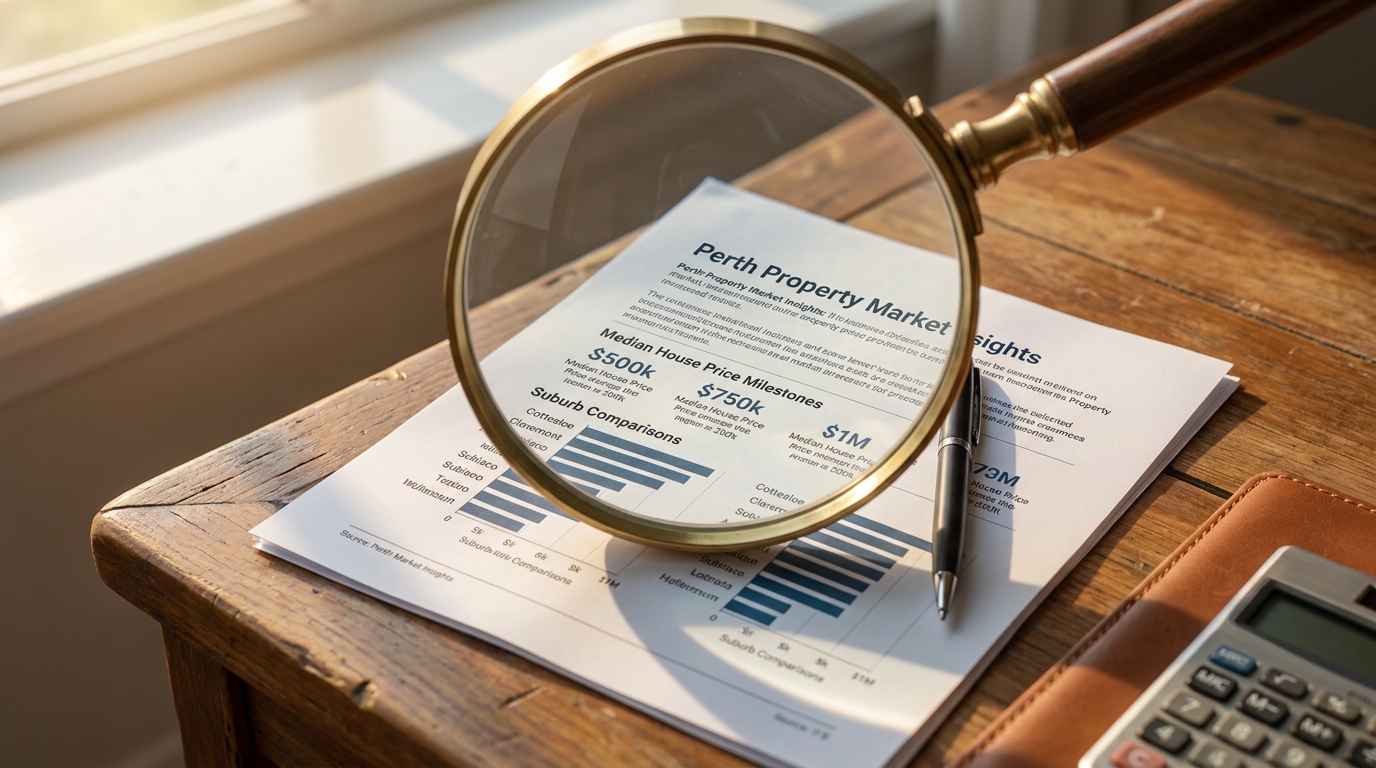
The short answer: Perth's median house price crossed $1 million in late 2025, driven by tight supply, strong interstate migration, and sustained wage growth. The metro median now sits around $1.09 million according to Domain's December 2025 data, with quarterly growth rates near 10%, the fastest appreciation in Australia. For investors, this creates both opportunity and risk: strong capital growth potential in undersupplied corridors, but stretched affordability and serviceability constraints that demand careful strategy. For many buyers priced out of premium suburbs like Cottesloe or Mount Lawley, rentvesting offers a practical alternative, renting centrally while building equity in higher-yield growth corridors where the entry cost sits below $750,000.
Perth's property market has entered a new era. The median house price broke through the psychological $1 million barrier in December 2025, a milestone that seemed distant just three years ago when the same metric sat at $568,000. This 91% surge in five years represents the sharpest residential price acceleration of any Australian capital, fuelled by a structural housing shortage, record interstate migration, and a resources sector paying wages that support borrowing capacity. For property investors, the question is no longer whether Perth offers value, it's how to position within a market where entry costs have fundamentally reset. Understanding what drives the perth median house price, how it varies across suburbs and property types, and where the growth trajectory leads is essential for anyone building wealth through Western Australian real estate in 2026.
The perth median house price didn't reach $1 million by accident. Three structural forces converged: chronic undersupply, a population boom, and economic conditions that support both demand and borrowing. According to REIWA, Perth recorded just 8,200 active listings in December 2025, the lowest inventory level in over a decade relative to population. At the same time, net interstate migration to Western Australia hit 22,000 people in the 2024-25 financial year, the highest inflow since the mining boom of 2012. When you combine scarce stock with surging demand, prices move quickly. Domain's December 2025 House Price Report showed the perth median house price climbed 9.9% in a single quarter, adding $98,000 in 90 days. That's roughly $6,000 per week in value growth, faster than most households can save for a deposit.
Western Australia's residential construction pipeline has struggled to keep pace with demand since 2020. Data from the Housing Industry Association shows Perth completed approximately 14,500 new dwellings in 2024, well below the estimated 20,000+ required annually to meet population growth and household formation. The construction lag stems from labour shortages, material cost inflation, and a decade of underbuilding following the mining downturn. Between 2015 and 2020, Perth's dwelling approvals averaged just 12,000 per year, creating a cumulative shortfall of tens of thousands of homes. This deficit now underpins the perth median house price trajectory. When listings fall below 10,000 and buyer demand remains strong, sellers hold pricing power. REIWA's median days on market dropped to 18 days in December 2025, down from 28 days a year earlier. Properties are selling faster and at higher prices because buyers have fewer alternatives.
Perth's population growth is the demand-side driver. The Australian Bureau of Statistics reported Western Australia's population grew 2.1% in the year to June 2025, the fastest rate of any state. Interstate migrants are drawn by job opportunities in mining, construction, and professional services, sectors where median wages exceed the national average. According to the Australian Taxation Office, Western Australia's median taxable income was $68,400 in 2023-24, compared to $62,000 nationally. Higher incomes translate to higher borrowing capacity, which supports higher purchase prices. A household earning $150,000 combined can service a mortgage of approximately $900,000 at current interest rates, enough to compete for properties near the perth median house price. The wage-to-price ratio in Perth remains more favourable than Sydney or Melbourne, where median house prices sit at $1.4 million and $1.0 million respectively but median incomes are only marginally higher.
The $1.09 million metro median masks enormous variation across Perth's geography. Inner-city suburbs like Subiaco and Mount Lawley command medians above $1.5 million, while growth corridors in the north and south offer entry points below $700,000. Understanding this spread is critical for investors, the strategy that works in Baldivis won't work in Cottesloe, and vice versa. REIWA's December 2025 data shows the perth median house price in the City of Perth (postcode 6000) sits at approximately $1.37 million, reflecting the premium for proximity to the CBD, amenity, and established infrastructure. Move 15 kilometres south to Canning Vale, and the median drops to $780,000. Move 30 kilometres north to Yanchep, and it's $620,000. These aren't just price differences, they're different investment propositions with different yield, growth, and risk profiles.
Perth's premium suburbs, Cottesloe, Claremont, Nedlands, Subiaco, have seen the perth median house price climb well above $1.5 million, with waterfront and heritage properties exceeding $3 million. These areas offer lifestyle appeal, established schools, and proximity to employment hubs, but rental yields are typically low. A $1.8 million house in Cottesloe might rent for $1,200 per week, delivering a gross yield of just 3.5%. For investors, that means meaningful negative cashflow unless the property is held with substantial equity and minimal debt. The capital growth story is strong, Cottesloe's median has grown 78% over five years, but the holding cost makes it unsuitable for portfolio builders focused on cashflow and serviceability. Premium suburbs work best for high-net-worth investors who can afford to carry the property and are prioritising long-term capital appreciation over income.
Perth's outer suburbs, Baldivis, Byford, Ellenbrook, Yanchep, offer a different equation. The perth median house price in these areas ranges from $600,000 to $750,000, and rental yields sit between 4.5% and 5.5%. A $650,000 house in Byford renting for $550 per week delivers a 4.4% gross yield, which translates to closer-to-neutral cashflow when depreciation and tax deductions are factored in. These corridors are experiencing strong population growth driven by affordability and new land releases. According to the Urban Development Institute of Australia, Baldivis and Byford were among the top five growth suburbs in Perth for new lot sales in 2024. Infrastructure investment follows population, the Tonkin Highway extension and Byford rail line are both under construction, improving connectivity to the CBD. For investors, growth corridors offer the dual benefit of lower entry cost and stronger rental yield, making them more suitable for portfolio building where serviceability and cashflow matter.
The data behind the perth median house price tells a story of sustained, broad-based growth rather than speculative froth. Domain's December 2025 House Price Report recorded a quarterly increase of 9.9%, the strongest three-month gain of any Australian capital. Over 12 months, Perth's median climbed 22.4%, compared to 8.1% in Sydney and 6.3% in Melbourne. This isn't a single-suburb spike driven by a handful of luxury sales, it's metro-wide momentum supported by fundamentals. REIWA's data shows median sale prices increased across 87% of Perth's suburbs in 2026, with 34 suburbs recording annual growth above 25%. The breadth of growth suggests the market is being driven by structural demand rather than speculative buying. When prices rise in Cottesloe and Baldivis simultaneously, it signals a supply-demand imbalance affecting the entire metro area.
| Factor | What it is | Impact |
|---|---|---|
| Quarterly growth rate | 9.9% in Dec 2025 quarter | Fastest capital appreciation in Australia |
| Annual growth rate | 22.4% over 12 months | Outpacing wage growth, stretching affordability |
| Five-year growth | 91% from $568k to $1.09m | Strongest capital city performance since 2020 |
| Median days on market | 18 days in Dec 2025 | Seller's market, limited negotiation window |
| Active listings | 8,200 properties metro-wide | Lowest inventory in a decade, driving competition |
Perth's rental market is equally tight. REIWA reported the median weekly rent for a house reached $750 in December 2025, up 15.4% year-on-year. Vacancy rates sit at 0.7%, well below the 2-3% range considered balanced. When vacancy is below 1%, tenants compete for properties, rents rise, and landlords hold pricing power. For investors, this translates to strong rental yields and low vacancy risk. A property purchased at the perth median house price of $1.09 million generating $750 per week in rent delivers a gross yield of 3.6%, modest by historical standards but improving as rents continue to climb faster than purchase prices. In growth corridors where purchase prices are lower and rents are proportionally higher, yields reach 4.5-5.5%, creating positive or near-positive cashflow positions. Research from CoreLogic shows Perth recorded the highest rental growth of any Australian capital in 2026, with house rents up 15.4% and unit rents up 12.8%. This rental strength supports both cashflow and capital growth, properties that generate strong income tend to attract investor demand, which in turn supports price appreciation.
Perth's performance stands out in national context. According to CoreLogic's December 2025 data, Perth's annual house price growth of 22.4% exceeded Sydney (8.1%), Melbourne (6.3%), Brisbane (14.2%), and Adelaide (10.7%). The perth median house price of $1.09 million is now higher than Melbourne's $1.0 million but still below Sydney's $1.4 million. What makes Perth's trajectory notable is the speed of the catch-up. In 2020, Perth's median was 40% below Sydney's. By 2026, that gap had narrowed to 22%. If current growth rates persist, Perth could match Sydney's median by 2027. However, affordability constraints are beginning to bite. The ratio of median house price to median household income in Perth has climbed from 5.8 in 2020 to 8.2 in 2026, according to analysis by the Bankwest Curtin Economics Centre. When price-to-income ratios exceed 8, first-home buyers struggle to enter the market without major parental assistance or dual high incomes, which can slow demand growth over time.
Ready to take the next step with Somerstone Property Group? Perth's $1.09 million median now sits 36% below the Sydney median house price of $1.7 million, but the gap is closing faster than most analysts predicted three years ago. The structural forces shaping median price growth, supply shortages, migration, and wage strength, are explored in detail in our analysis of the broader Perth property market dynamics through 2026.
Our team is ready to help you achieve your goals. Book a discovery call.
The question every investor asks: can this growth continue, or are we approaching a correction? The answer depends on supply, demand, and macroeconomic conditions over the next 24-36 months. On the supply side, Perth's construction pipeline is improving but still insufficient. The Housing Industry Association forecasts 16,500 dwelling completions in 2026, up from 14,500 in 2024 but still below the 20,000+ required to meet population growth. Until supply catches up, the structural shortage will continue to support the perth median house price. On the demand side, migration remains strong but is sensitive to economic conditions. If the resources sector slows or interstate migration reverses, demand could soften quickly. Interest rates are the wildcard. The Reserve Bank of Australia held the cash rate at 4.35% through 2025, but any further increases would reduce borrowing capacity and cool buyer demand.
Three risks could stall or reverse Perth's price growth. First, affordability is already stretched. A household earning the median income of $68,400 can service a mortgage of approximately $410,000 at current rates, less than half the perth median house price. This means median-income earners are effectively priced out unless they have large savings, dual incomes, or parental assistance. When the bottom 50% of income earners can't afford the median property, demand becomes concentrated among higher earners and investors, which can create volatility. Second, interest rate risk remains. If the RBA raises rates by another 50 basis points, borrowing capacity falls by approximately 5%, which could reduce the pool of qualified buyers and slow price growth. Third, oversupply risk exists in some outer suburbs where large land releases are underway. If construction ramps up faster than population growth in areas like Yanchep or Baldivis, rental vacancies could rise and yields could compress, reducing investor demand.
For investors who understand the risks, Perth offers compelling opportunities. The perth median house price growth has been fastest in undersupplied middle-ring suburbs with strong infrastructure investment, areas like Cockburn, Canning, and Stirling. These suburbs benefit from proximity to employment hubs, established amenity, and limited new land supply, creating a structural shortage that supports both capital growth and rental demand. Dual-key and multi-income properties are particularly powerful in this environment. A dual-key property purchased for $650,000 in a growth corridor generating two rental incomes of $350 per week each delivers a gross yield of 5.6%, greatly higher than a single-dwelling house at the same price point. This yield advantage improves cashflow, supports serviceability for additional purchases, and reduces vacancy risk. As the perth median house price continues to rise, strategies that maximise rental income per dollar invested become increasingly important for portfolio sustainability.
Navigating a market where the perth median house price exceeds $1 million requires a different approach than buying in a $600,000 market. Entry costs are higher, serviceability is tighter, and the margin for error is smaller. The first step is clarity on strategy: are you building a portfolio for long-term wealth, or are you buying a single investment property? If it's the former, cashflow and serviceability matter more than capital growth in the first purchase. A positively cashflowed property in a growth corridor preserves borrowing capacity for the next acquisition. If it's the latter, you can afford to prioritise capital growth and accept negative cashflow. The second step is understanding your equity position and borrowing capacity. A detailed assessment with a qualified mortgage broker will reveal how much you can borrow, how much deposit you need, and how many properties you can realistically acquire over the next five years.
Not all properties at the perth median house price deliver the same investment outcome. A $1.09 million house in Subiaco and a $1.09 million dual-key property in Byford have completely different yield, growth, and cashflow profiles. The Subiaco house might deliver 3.5% gross yield and strong capital growth but require $2,000 per month in top-up from your salary. The Byford dual-key might deliver 5.5% gross yield, moderate capital growth, and positive cashflow from day one. For portfolio builders, the Byford option is superior because it doesn't drain serviceability. For high-net-worth investors with surplus income, the Subiaco option might align better with long-term wealth goals. The key is matching the property to your financial position and strategy, not chasing the suburb with the highest recent growth. Data from Propertyology shows the top-performing Perth suburbs for investor returns over the past decade were not the most expensive, they were middle-ring suburbs with strong population growth, infrastructure investment, and rental demand.
Timing the perth median house price is impossible, but timing your entry relative to your financial readiness is essential. Buying at the peak of a growth cycle with maximum leverage and minimal equity buffer creates risk. Buying when you have strong serviceability, sufficient deposit, and a clear 10-year plan creates resilience. The best investors don't try to pick the bottom, they buy when the fundamentals align with their strategy and hold through cycles. Patience matters because property is a long-term asset class. A property purchased at $1.09 million today might be worth $1.5 million in five years, but it might also dip to $1.0 million in year two if interest rates spike or supply increases. If you're forced to sell in year two, you lose. If you can hold for 10 years, short-term volatility becomes irrelevant. Portfolio construction is about building a system where each property supports the next. The first property should generate enough income and equity growth to fund the second. The second should do the same for the third. Over time, the compounding effect of multiple properties growing in value and generating income creates wealth that a single property cannot match.
The perth median house price crossing $1 million marks a structural shift in Western Australia's property market. This isn't a temporary spike, it's the result of sustained undersupply, strong population growth, and economic conditions that support both demand and borrowing. For investors, the opportunity lies in understanding that the metro median is an average, not a target. Growth corridors offer lower entry costs and stronger yields, while premium suburbs offer capital growth at the expense of cashflow. The right strategy depends on your income, equity, borrowing capacity, and long-term goals. What's clear is that waiting for prices to fall back to 2020 levels is not a strategy, the structural shortage and migration trends suggest Perth's median will continue rising, albeit at a slower pace than the 22% annual growth of 2026. The investors who build wealth in this environment will be those who act with clarity, focus on cashflow and serviceability, and construct portfolios designed to compound over decades.
The Perth median house price reached approximately $1.09 million in December 2025 according to Domain's House Price Report, representing a 22.4% annual increase. REIWA data shows the metro median at $840,000 for settled sales, with variation depending on methodology and timing. Expect continued growth in 2026, though at a slower pace than 2025's record 9.9% quarterly rise. Perth's 22.4% annual growth sits within a national context where Australian house prices are diverging sharply by capital city, creating distinct opportunities and risks depending on geography. While Perth's median has overtaken Melbourne's $1.0 million benchmark, the two cities present contrasting investment cases, a comparison detailed in our coverage of Melbourne house prices and their slower growth trajectory.
Growth corridors like Baldivis, Byford, Ellenbrook, and Yanchep offer median house prices between $600,000 and $750,000, well below the metro median. These suburbs deliver stronger rental yields (4.5-5.5%) and benefit from infrastructure investment, making them suitable for investors prioritising cashflow and portfolio growth over premium location.
Perth's median house price of $1.09 million now exceeds Melbourne ($1.0 million) but remains below Sydney ($1.4 million). Perth recorded the strongest annual growth of any capital in 2025 at 22.4%, compared to Sydney's 8.1% and Brisbane's 14.2%. The gap between Perth and Sydney has narrowed greatly since 2020.
Yes, but strategy matters more than ever. Focus on properties that generate positive or neutral cashflow to preserve borrowing capacity for subsequent purchases. Dual-key and multi-income properties in growth corridors offer stronger yields than single-dwelling houses at the same price point, making portfolio expansion more sustainable despite higher entry costs.
Three risks: interest rate increases reducing borrowing capacity, economic slowdown affecting migration and employment, or accelerated construction creating oversupply in outer suburbs. However, Perth's structural housing shortage and strong population growth provide a buffer against sharp corrections. Any pullback would likely be modest compared to the 91% growth since 2020.
