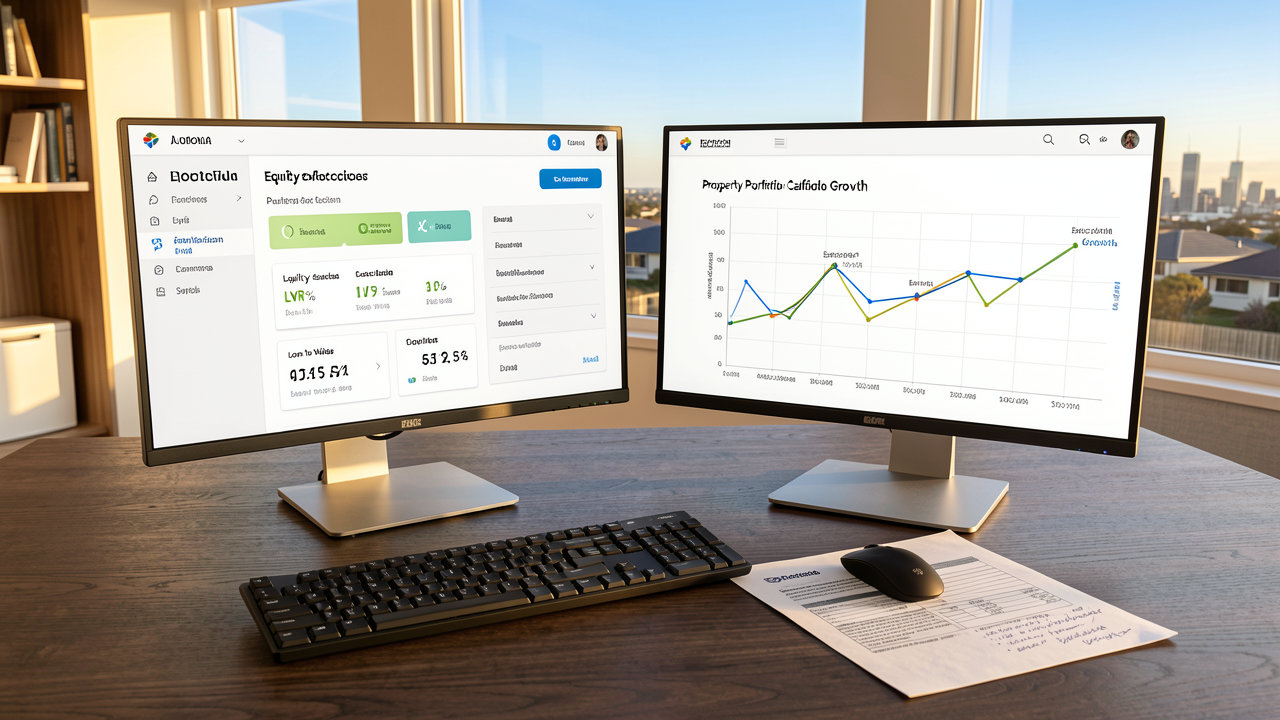
The short answer: You can leverage equity in a rental property by accessing the difference between its current value and your loan balance through cash-out refinancing, a home equity line of credit (HELOC), or a second mortgage. Most lenders allow access to 75-80% of the property's value minus existing debt, which you can then use as a deposit for additional investments or other purposes while keeping the original property. Many investors combine equity extraction with rentvesting, renting where they want to live while leveraging their investment property equity to fund additional purchases in high-yield markets.
Property equity isn't just a number on a balance sheet, it's dormant capital that can fund your next investment, accelerate portfolio growth, or provide financial flexibility when you need it. For rental property owners, understanding how to leverage equity in a rental property is the difference between staying stuck at one property and building genuine wealth through compounding real estate holdings.
Most investors know they have equity. Fewer understand how much they can actually access, which financing method suits their situation, or whether the property will still cashflow after extraction. The mechanics matter enormously, the wrong structure can turn a positive-cashflow asset into a monthly drain, destroy your borrowing capacity for future purchases, or lock you into unfavourable terms for decades.
This guide breaks down the practical steps, financing options, and risk considerations for accessing rental property equity in 2026. You'll learn how to calculate usable equity, compare refinancing versus credit lines, maintain cashflow after extraction, and position your portfolio for continued growth rather than overleveraging into stagnation.
Equity is the portion of your property you truly own, the current market value minus what you still owe. A rental property worth $500,000 with a $300,000 mortgage has $200,000 in total equity. That's straightforward. What confuses most investors is the gap between total equity and usable equity, the amount lenders will actually let you access.
Banks don't lend against 100% of a property's value. Investment property lending in Australia typically caps at 75-80% loan-to-value ratio (LTV), meaning the maximum combined debt against the property can't exceed that threshold. Your usable equity is the difference between that lending ceiling and your current loan balance, minus transaction costs.
The formula is simple but critical to understand before approaching any lender. Take your property's current market value and multiply it by the lender's maximum LTV (typically 0.75 or 0.80 for investment properties). Subtract your existing mortgage balance and any transaction costs, that's your usable equity.
Consider a property valued at $600,000 with an outstanding mortgage of $350,000. If the lender allows 80% LTV, the maximum secured debt is $480,000. Subtracting the existing $350,000 loan gives you $130,000 in gross borrowing capacity. After allowing $5,000-$8,000 for refinancing costs and lender fees, your net usable equity sits around $122,000-$125,000.
According to CoreLogic data, Australian property values grew 8.1% nationally in 2024, meaning many investors who purchased three to five years ago are sitting on major equity growth they haven't yet accessed. That accumulated equity becomes the fuel for portfolio expansion, but only if you understand how to leverage equity in a rental property without compromising the asset's performance.
The 75-80% LTV ceiling exists because lenders need a buffer against market volatility and default risk. Investment properties carry higher risk than owner-occupied homes, vacancy periods, tenant damage, and market downturns all affect the asset's ability to service debt. By capping lending at 80%, the bank maintains a 20% equity cushion that protects them if they need to sell the property in foreclosure.
Higher LTV products exist, some lenders offer 85-90% LTV for investment properties, but they come with considerably higher interest rates, lender's mortgage insurance (LMI), and stricter serviceability tests. For most investors, the additional cost outweighs the marginal increase in borrowing capacity. The 80% threshold represents the sweet spot where borrowing cost, equity access, and risk management intersect.
Your borrowing capacity also depends on serviceability, the lender's assessment of whether you can comfortably meet repayments under stressed conditions. They assess your income, existing debts, living expenses, and the rental income from the property itself. A property generating strong rental yield improves serviceability and supports higher borrowing. A negatively geared property with weak cashflow constrains it.
| Factor | What it is | Impact |
|---|---|---|
| Current property value | Market valuation today | Higher value = more equity |
| Outstanding loan balance | What you still owe | Lower balance = more equity |
| Lender LTV cap | Maximum debt allowed | 80% typical for investment |
| Transaction costs | Fees, valuation, legals | Reduces net usable equity |
| Serviceability assessment | Can you afford repayments? | Determines approval regardless |
Once you know how much equity you can access, the next decision is which financing structure to use. The three primary methods for learning how to leverage equity in a rental property are cash-out refinancing, a home equity line of credit (HELOC), and a second mortgage. Each has distinct cost structures, flexibility, and risk profiles. The same principles apply when accessing equity in your home to fund investment purchases, though owner-occupied properties typically allow higher LTV ratios and lower interest rates.
Cash-out refinancing replaces your existing mortgage with a larger loan and pays you the difference in cash. A HELOC establishes a revolving credit line secured against the property's equity, which you can draw on as needed. A second mortgage adds a separate loan on top of your existing mortgage, leaving the original loan untouched. The right choice depends on your interest rate, how you plan to use the funds, and whether you need immediate access or staged deployment.
Cash-out refinancing is the most common method for accessing rental property equity in Australia. You refinance the entire loan to a higher principal amount and receive the difference as a lump sum. If your current mortgage is $300,000 and you refinance to $420,000, you receive $120,000 cash (minus costs) and make repayments on the new $420,000 loan.
The advantage is simplicity, one loan, one interest rate, one repayment schedule. You can lock in a fixed rate if market conditions favour it, and the entire loan is tax-deductible if used for investment purposes. The disadvantage is that you reset your loan term. If you were 10 years into a 30-year mortgage, refinancing starts a new 30-year clock unless you specify otherwise, which increases total interest paid over the life of the loan.
Cash-out refinancing makes sense when current interest rates are equal to or lower than your existing rate, when you need a lump sum for a specific purpose (deposit on another property, renovation, debt consolidation), and when you want the discipline of a fixed repayment structure. According to the Reserve Bank of Australia, the average variable investment loan rate in early 2026 sits around 6.3-6.8%, making refinancing attractive for investors locked into higher rates from 2023-2024.
A HELOC functions like a credit card secured against your property. The lender approves a maximum credit limit based on your usable equity, and you draw funds as needed up to that limit. You only pay interest on the amount actually drawn, not the full approved limit. This makes HELOCs ideal when you're not sure exactly how much you'll need or when you'll need it, renovations with uncertain costs, multiple property deposits over time, or maintaining a capital buffer for opportunities.
HELOCs typically carry variable interest rates slightly higher than standard mortgage rates, often 0.3-0.5% above the lender's variable investment rate. The flexibility comes at a cost. Interest-only repayments are common during the draw period (usually 5-10 years), after which the line converts to principal-and-interest repayments. This structure can create a cashflow shock if you're not prepared for the transition.
The major risk with HELOCs is overuse. Because the funds are easily accessible, some investors treat them as an emergency fund or lifestyle supplement rather than strategic capital. Drawing equity to cover personal expenses or negatively geared property losses is a path to overleveraging. When considering how to leverage equity in a rental property through a HELOC, discipline matters more than with any other structure.
Accessing equity increases your debt, which increases your repayments. The critical question every investor must answer before extracting equity is whether the rental income will still cover the new debt load. A property that was positively cashflowed or neutral can easily flip to negative after refinancing if the numbers aren't modelled properly.
Let's work through a real scenario. You own a rental property worth $550,000 with a $280,000 mortgage at 6.5% interest. Monthly repayments are approximately $1,770 (principal and interest over 30 years). The property generates $2,600 per month in rent. After property management fees (8%), council rates, insurance, and maintenance allowance, your net monthly cashflow is roughly $400 positive. Equity extraction is the engine that allows investors to build a property portfolio beyond their initial deposit savings, turning one asset into multiple holdings through strategic refinancing.
You decide to access $100,000 in equity through cash-out refinancing, increasing your loan to $380,000. At the same 6.5% interest rate, your new monthly repayments jump to $2,400. Your rental income hasn't changed, still $2,600 gross. But now, after the same holding costs, your net monthly cashflow has dropped to negative $200. You've gone from $400 positive to $200 negative by accessing equity.
This is where most investors get caught. They focus on the equity amount they can access without modelling the repayment impact. The property is still the same asset generating the same rent, but the debt structure has fundamentally changed its cashflow profile. If you're using that $100,000 to purchase another investment property that itself generates positive cashflow, the portfolio outcome may still be strong. If you're using it for personal expenses or a negatively geared purchase, you've just weakened your overall position.
According to Australian Taxation Office data, approximately 1.2 million Australians own investment properties, and the majority are negatively geared, meaning they absorb losses annually. Adding more debt to an already negative asset accelerates that drain. Before you extract equity, model the new repayments at both the current interest rate and a stressed rate 2-3% higher. If the property can't service the debt under stress conditions, you're overleveraged.
Cashflow at the property level is one concern. Serviceability at the portfolio level is another. Lenders assess your total income against your total debt obligations, mortgage repayments across all properties, credit card limits, car loans, personal expenses. Every dollar a property costs you per month reduces what you can borrow next time.
This is why understanding how to leverage equity in a rental property strategically matters so much. A property that remains cash neutral or positive after equity extraction preserves or even improves your borrowing capacity for the next acquisition. A property that flips to heavy negative gearing constrains it. If your goal is portfolio growth, cashflow discipline is non-negotiable.
The solution often lies in property selection and structure. Standard residential properties yielding 3-4% gross struggle to remain cash positive after high leverage. Dual-key or multi-income properties yielding 6-7% gross have far more cushion. When the rent substantially exceeds the repayments, you can extract equity without destroying the asset's performance.
Ready to take the next step with Somerstone Property Group?
Our team is ready to help you achieve your goals. Book a discovery call.
The most common reason investors want to learn how to leverage equity in a rental property is to fund the deposit and acquisition costs for the next one. This is equity recycling, using the accumulated wealth in property one to acquire property two, then repeating the process as property two builds equity. Done correctly, it's the engine of multi-property portfolio construction.
A $600,000 property with $450,000 in debt and $150,000 in equity can potentially release $90,000-$100,000 in usable equity at 80% LTV. That $90,000 becomes the deposit for a $450,000 investment property (assuming 20% deposit requirement), which itself begins generating rental income and building equity. After three to five years, property two has appreciated and paid down principal, creating equity that can fund property three.
The mechanics of using equity for a deposit involve either cash-out refinancing to receive a lump sum or establishing a HELOC that you draw on when the new property settles. Most investors use cash-out refinancing because lenders and conveyancers prefer seeing cleared funds in your account during the purchase process. A HELOC works but requires careful coordination with your broker and solicitor to ensure the drawdown timing aligns with settlement.
When you extract equity to purchase another property, the interest on that extracted portion is tax-deductible because the borrowed funds are being used for income-producing purposes. This is critical for tax planning. If you extracted $100,000 and used $80,000 for a property deposit and $20,000 for a personal holiday, only the $80,000 portion remains deductible. Keep the funds quarantined in separate accounts and maintain clear records, the Australian Taxation Office scrutinises mixed-use borrowings. Your usable equity calculation depends entirely on accurate property price assessment, which is why most lenders require a formal valuation rather than accepting online estimates.
The new property must be able to service its own debt from rental income and your remaining borrowing capacity. Lenders assess the combined serviceability of your entire portfolio. If property one is now heavily negatively geared after equity extraction and property two is also negatively geared, the cumulative cashflow drain may prevent approval even if you have the deposit. This is where yield-focused strategies outperform capital-growth-only approaches, properties that pay for themselves don't drag down your ability to keep buying.
Somerstone Property Group's Premium Investment Concierge model approaches equity leverage as part of a broader portfolio strategy rather than isolated transactions. Their process maps a 10-year acquisition roadmap that models how each property's equity and cashflow interact with the next, ensuring clients don't extract equity in a way that traps them at two properties when the strategy called for five. It's one option for investors who want the strategy managed holistically rather than piecing it together transaction by transaction.
The compounding effect of equity recycling is powerful but requires discipline. A common mistake is extracting equity too early, before the property has appreciated enough to create meaningful usable equity, or too aggressively, leaving no buffer for market downturns. A conservative approach waits until the property has at least 30-40% total equity before extracting, ensuring you're not immediately back at high LTV if values dip.
Another mistake is chasing yield without assessing location fundamentals. A property offering 8% gross yield in a declining mining town may look attractive on paper, but if capital values fall 10% and vacancy rises, the yield becomes irrelevant. Sustainable portfolio growth requires properties in locations with genuine demand drivers, population growth, infrastructure investment, employment diversity, and lifestyle amenity. That's the foundation before leverage enters the equation.
Leverage amplifies both gains and losses. When property values rise and rents increase, leverage accelerates your wealth accumulation because you control a larger asset base with less of your own capital. When values fall or cashflow deteriorates, leverage magnifies the damage because your debt obligations remain fixed while your equity and income shrink.
The primary risks of leveraging equity in a rental property include interest rate increases that blow out repayments, market downturns that erode equity and trap you in negative equity positions, vacancy periods that leave you covering full holding costs from your own pocket, and serviceability constraints that prevent further borrowing even when opportunities arise. Each risk is manageable with proper structure and planning, but none should be ignored.
Variable-rate loans expose you to interest rate fluctuations. A 1% rate increase on a $400,000 loan adds roughly $330 per month to your repayments. If you've extracted equity and are already running tight on cashflow, that increase can force you into financial stress quickly. According to the Reserve Bank of Australia, the cash rate moved from 0.1% in April 2022 to 4.35% by late 2023, the fastest tightening cycle in decades. Investors who had overleveraged on low rates found themselves unable to service debt when repayments doubled.
The solution is to stress-test your repayments at rates 2-3% above the current level before extracting equity. If your property can't service the debt at 9% when you're borrowing at 6.5%, you're taking on more risk than the asset can handle. Fixed-rate loans provide certainty but come with break costs if you need to refinance early and often carry slightly higher rates than variable products. A split loan, part fixed, part variable, can balance certainty with flexibility.
Maintaining a repayment buffer is non-negotiable. This means either holding cash reserves equal to 6-12 months of mortgage repayments or ensuring your properties generate enough positive cashflow to absorb rate rises without requiring top-ups. Investors who rely on their salary to cover investment property losses are one job loss or income reduction away from a forced sale. The cashflow stress test becomes even more critical when using home equity to fund purchases, as you're now servicing debt across both your residence and investment properties.
Negative equity occurs when your property's market value falls below your outstanding loan balance. If you purchased at $500,000 with an $400,000 loan (80% LTV) and values drop 15%, your property is now worth $425,000 but you still owe $400,000. You have only $25,000 in equity, a 5.9% buffer. If you had extracted equity and pushed your loan to $440,000, you'd be underwater.
Negative equity doesn't matter if you're not selling and can continue servicing the debt. The property will eventually recover. But if you're forced to sell during the downturn, job loss, family emergency, inability to cover repayments, you'll crystallise the loss and potentially still owe the bank after the sale. This is the danger of high leverage combined with poor cashflow.
Risk management here means conservative LTV targets and location selection. Keeping your total debt below 75% LTV provides a meaningful buffer against market volatility. Buying in locations with strong demand fundamentals, population growth, infrastructure investment, employment diversity, reduces the likelihood of severe, sustained value declines. Speculative markets with weak fundamentals are where overleveraged investors get hurt most.
Most lenders allow access to 75-80% of your property's current value minus your existing loan balance. On a $500,000 property with a $300,000 mortgage, you could access approximately $80,000-$100,000 after costs, depending on the lender's LTV policy and your serviceability assessment.
Yes. Extracting equity increases your debt obligations, which lenders assess when calculating serviceability for future loans. If the property remains cash positive or neutral after extraction, the impact is minimal. If it becomes heavily negatively geared, your borrowing capacity for the next purchase will be constrained considerably.
Cash-out refinancing suits investors who need a lump sum for a specific purpose and want a fixed repayment structure. A HELOC suits those who need flexible, staged access to funds over time. HELOCs typically carry slightly higher interest rates and require more discipline to avoid overuse.
Your debt remains the same regardless of property value changes. If values drop greatly and push you into negative equity, you're not forced to act unless you need to sell or refinance. Maintain strong cashflow and a repayment buffer so you can ride out market cycles without distress selling.
Yes, but tax treatment changes. Interest on debt used to purchase an investment property is tax-deductible. Interest on debt used to purchase a home you'll live in is not. Structure the loans carefully and consult your accountant to ensure you're not inadvertently losing deductions or creating mixed-use debt issues.
Knowing how to leverage equity in a rental property is essential for any investor serious about building a multi-property portfolio. The process involves calculating usable equity at 75-80% LTV, choosing the right financing structure, cash-out refinance, HELOC, or second mortgage, and stress-testing the property's cashflow under higher debt loads and interest rate scenarios.
The most successful investors treat equity extraction as part of a broader portfolio strategy, not an isolated transaction. They model how each property's equity and cashflow interact with the next acquisition, maintain conservative LTV ratios to weather market volatility, and prioritise properties that remain cash positive or neutral after leverage. Equity is dormant capital, but only if you can access it without destroying the asset's performance or your ability to keep growing.
Before extracting equity, run the numbers. Model the new repayments, stress-test at higher interest rates, confirm the property will still cashflow, and ensure your overall serviceability supports the next step in your plan. Leverage accelerates wealth when used strategically. It destroys it when applied recklessly.
